Shareable Image
Deep indigo color background with HEX code, RGB values and color meaning
Deep indigo color background with HEX code, RGB values and color meaning
Deep indigo color background with HEX code, RGB values and color meaning explores the rich, mysterious blue-violet color traditionally positioned between violet and blue in the VIBGYOR rainbow sequence. This educational infographic presents indigo through a beautiful deep-colored background, a clearly labeled circular swatch, digital color specifications, and a scientific explanation of its relationship with the visible spectrum. Represented by the hexadecimal code #4B0082, indigo combines a strong blue component with a smaller red component to create a dark, saturated color associated with depth, sophistication, imagination, contemplation, and elegance.
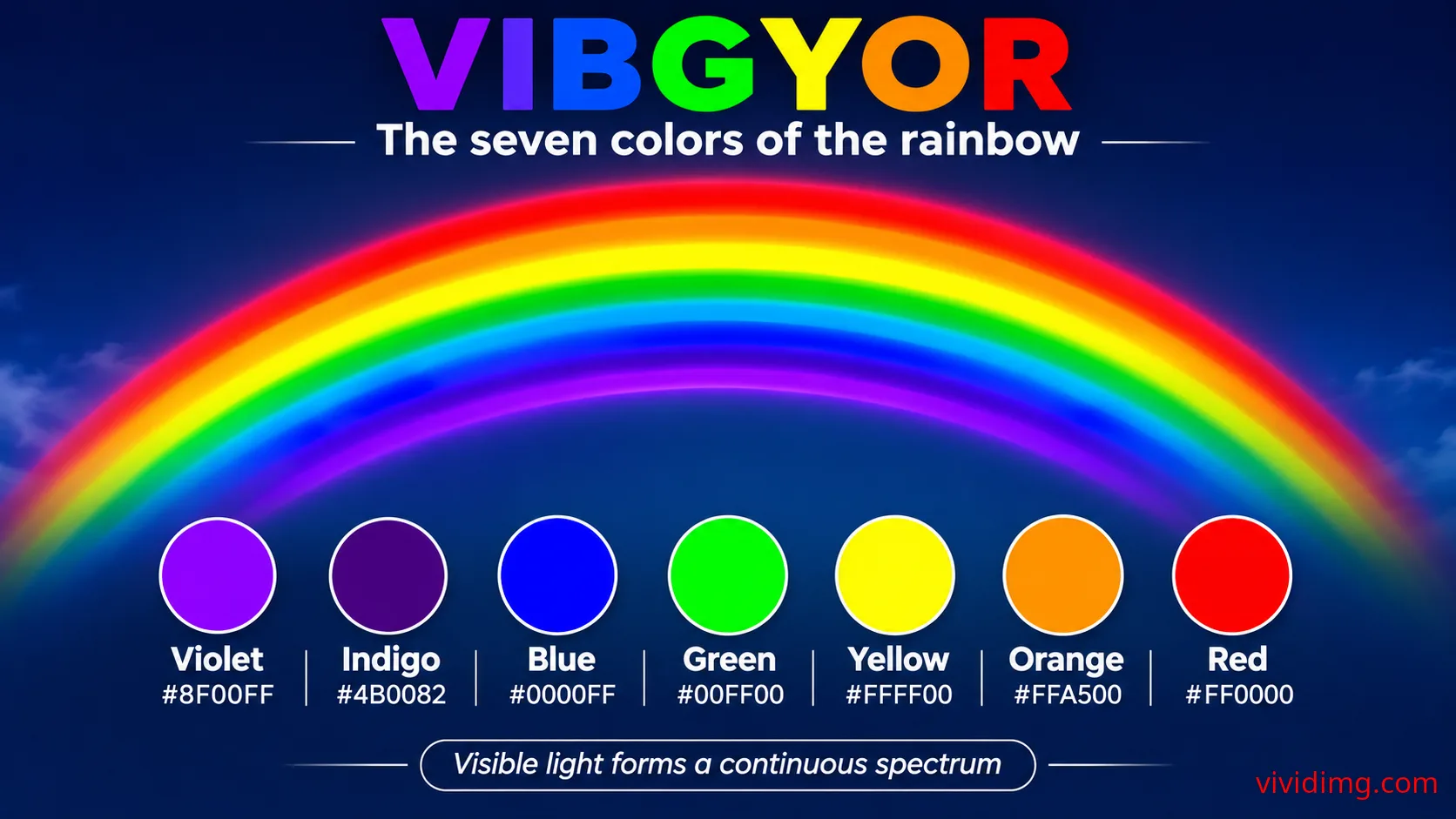
Indigo is the second color in the traditional VIBGYOR mnemonic, which stands for Violet, Indigo, Blue, Green, Yellow, Orange, and Red. Although it is widely taught as one of the seven rainbow colors, indigo does not have a universally accepted wavelength range separating it from blue and violet. This makes it particularly interesting for understanding how scientific observations, historical classifications, cultural naming conventions, and digital color representations interact.
The infographic features a deep indigo background, a large white INDIGO heading, and a classification label reading Spectral region / cool color family. A dark navy information panel along the bottom contains a circular indigo swatch, technical color values, and an explanation of indigo's traditional position in VIBGYOR.
What is indigo?
Indigo is a deep blue-violet color that lies visually between blue and violet. In everyday color terminology, it is often described as a dark bluish-purple or violet-blue shade. The exact appearance associated with indigo varies across historical sources, artistic traditions, dyeing practices, and modern digital color systems.
Indigo is a chromatic color because it has an identifiable hue and saturation. It is generally classified as a cool color due to its strong association with blue and violet. Its dark appearance makes it especially useful for creating dramatic backgrounds, sophisticated palettes, and high-contrast visual compositions.
The digital reference used in this image is #4B0082. This is the standard CSS named color indigo, making it a practical and recognizable reference for web development and digital design.
Indigo color technical specifications
Color name: Indigo
HEX code: #4B0082
RGB: (75, 0, 130)
HSL: Approximately (275°, 100%, 25.5%)
HSV / HSB: Approximately (275°, 100%, 51%)
CMYK: Approximately (42%, 100%, 0%, 49%) using a simplified mathematical conversion
Color family: Blue-violet
Color classification: Chromatic
Traditional rainbow position: Between violet and blue
Color temperature: Cool
HSL saturation: 100%
HSL lightness: Approximately 25.5%
HSV brightness: Approximately 51%
Reference color space: sRGB
CSS color keyword: indigo
These values describe the specific digital color #4B0082. They should not be interpreted as universal specifications for every shade described as indigo. Indigo dyes, pigments, natural materials, and other digital representations can have different color characteristics.
The CMYK values are approximate. Professional printing requires a suitable ICC color profile and consideration of ink, paper, printing technology, and color-management settings.
Understanding the indigo HEX code #4B0082
A hexadecimal color code represents red, green, and blue channel values using six hexadecimal digits. The first pair specifies red, the second specifies green, and the third specifies blue. Each pair ranges from 00 to FF, equivalent to decimal values from 0 to 255.
For indigo #4B0082, the hexadecimal pair 4B corresponds to red at 75, 00 corresponds to green at 0, and 82 corresponds to blue at 130. The resulting RGB representation is (75, 0, 130).
The blue channel is stronger than the red channel, while the green channel is zero. This combination creates a saturated blue-violet appearance. Its relatively low RGB channel values contribute to the dark visual character of the color.
Equivalent representations include:
HEX: #4B0082
RGB: rgb(75, 0, 130)
HSL: approximately hsl(275, 100%, 25.5%)
HSV: approximately (275°, 100%, 51%)
CSS keyword: indigo
Because indigo is a predefined CSS named color, developers can use either the keyword indigo or the hexadecimal code #4B0082 to represent the same nominal sRGB color.
Indigo in the HSL color model
HSL stands for Hue, Saturation, and Lightness. Hue identifies a position around the RGB-derived color wheel, saturation describes color intensity, and lightness describes the position between black and white within the HSL model.
Indigo #4B0082 has an approximate HSL representation of (275°, 100%, 25.5%). Its hue places it between blue at 240° and magenta at 300°. This position explains why indigo belongs to the blue-violet family.
The saturation of 100% indicates maximum saturation within the HSL model. The lightness of approximately 25.5% indicates a relatively dark color.
HSL lightness is not equivalent to physical luminance or perceived brightness. Different hues with identical HSL lightness values can appear significantly different in brightness.
Indigo in the HSV color model
HSV stands for Hue, Saturation, and Value. It is also called HSB, where B represents brightness. This model is commonly used in digital illustration applications, color pickers, image editors, and graphic design software.
The featured indigo has an approximate HSV representation of (275°, 100%, 51%). The hue identifies its blue-violet position, saturation indicates maximum HSV saturation, and value describes the largest normalized RGB channel.
Because the blue channel is 130 out of 255, the HSV value is approximately 51%. This numerical value does not mean that indigo appears exactly half as bright as white. HSV brightness is based on RGB channel values rather than a perceptually uniform measurement.
Indigo and the visible light spectrum
Visible light is the portion of electromagnetic radiation that human eyes can detect. It is commonly described as extending approximately from 380 to 700 nanometers, although the exact limits depend on the observer and measurement conditions.
The traditional VIBGYOR classification places indigo between violet and blue. However, modern scientific descriptions of the visible spectrum do not consistently assign indigo a separate wavelength interval. Instead, indigo is commonly treated as part of the gradual transition between violet and blue.
Some educational references associate indigo with wavelengths around 425–450 nanometers, but these values are approximate conventions rather than universally accepted physical boundaries. Natural light changes continuously across the spectrum, and the perceived divisions between named colors are influenced by human vision and language.
The digital color #4B0082 is not equivalent to a single wavelength of light. An RGB display creates this indigo appearance by combining red and blue light contributions at specific intensities. A physical spectral color and its digital representation may look similar while having different spectral compositions.
Why indigo is included in VIBGYOR
The seven-color rainbow classification is historically associated with Isaac Newton's studies of light and color. Newton divided the continuous visible spectrum into seven named regions: red, orange, yellow, green, blue, indigo, and violet.
The familiar VIBGYOR mnemonic presents these colors in the reverse order, beginning with violet and ending with red. Indigo therefore appears as the second color when reading VIBGYOR.
Although seven-color rainbow diagrams remain widely used in education, modern color science recognizes that the visible spectrum contains continuous wavelength transitions rather than exactly seven physically separated color bands.
Indigo is especially useful for demonstrating the difference between traditional color naming and the continuous nature of visible light.
Indigo versus violet and blue
Indigo, violet, and blue belong to closely related regions of color perception, but they have different typical appearances.
Blue is generally associated with a hue near 240° in the RGB color wheel. Violet and purple-family digital colors often appear closer to the region between blue and magenta. Indigo commonly describes a darker blue-violet appearance.
Representative digital references include:
Violet: #8F00FF — RGB (143, 0, 255)
Indigo: #4B0082 — RGB (75, 0, 130)
Blue: #0000FF — RGB (0, 0, 255)
These examples illustrate the differences between the selected educational colors. They do not establish exact spectral boundaries because the colors are RGB display references.
The selected indigo is substantially darker than the featured violet and blue references. Its reduced lightness is an important part of its visual identity.
Indigo color temperature and visual characteristics
Indigo is generally considered a cool color because of its relationship with blue and violet. Cool colors are often associated with depth, calmness, distance, and contemplative visual moods.
The featured #4B0082 indigo has a deep, saturated appearance. Its relatively low lightness creates a rich background that can support bright typography, luminous accents, and contrasting design elements.
Indigo can also appear warmer or cooler depending on its undertones. A blue-dominant indigo generally appears cooler, while an indigo containing stronger reddish or purple influences may appear comparatively warmer.
Indigo color psychology and symbolism
Indigo is commonly associated with wisdom, intuition, imagination, mystery, contemplation, creativity, and sophistication. Its deep appearance makes it popular in designs intended to communicate seriousness, elegance, or a reflective atmosphere.
Indigo also has important historical and cultural associations through indigo dye, which has been used in textile traditions across different parts of the world for centuries.
In modern branding and visual design, indigo can communicate individuality, confidence, depth, and premium quality. However, color symbolism is influenced by culture, personal experience, and context rather than fixed universal meanings.
The history of indigo dye
Indigo has a long history as a textile dye. Natural indigo pigments were traditionally obtained from plants containing compounds that can be processed to produce the blue dye indigotin.
Indigo dyeing has been practiced in different regions, including South Asia, Africa, and East Asia. India has a particularly significant historical association with indigo cultivation and textile production.
Traditional indigo-dyed fabrics often display rich blue shades that differ from the digital CSS indigo color #4B0082. The appearance of dyed fabric depends on dye concentration, fiber type, processing techniques, lighting, and repeated dyeing cycles.
Modern denim production is one of the best-known applications of indigo dye. Many blue jeans are colored using synthetic indigo dyes developed for industrial textile production.
This historical connection demonstrates how the same color name can describe a traditional dye, a broad family of visual shades, and a specific digital color reference.
Indigo color combinations and matching palettes
Indigo pairs well with neutral colors, soft pastel shades, metallic-inspired accents, and contrasting warm colors. Its dark appearance makes it especially useful as a foundation for sophisticated color palettes.
Useful combinations include:
Indigo and white: #4B0082 + #FFFFFF — Clean, high-contrast appearance
Indigo and black: #4B0082 + #000000 — Deep dramatic styling
Indigo and lavender: #4B0082 + #E6E6FA — Soft analogous harmony
Indigo and violet: #4B0082 + #8F00FF — Rich blue-violet composition
Indigo and blue: #4B0082 + #0000FF — Cool monochromatic-inspired palette
Indigo and gold: #4B0082 + #FFD700 — Elegant decorative contrast
Indigo and yellow-green: #4B0082 + #378200 — Hue-opposite relationship
Indigo and cyan: #4B0082 + #00FFFF — Vibrant cool-color contrast
Indigo and silver: #4B0082 + #C0C0C0 — Modern refined appearance
Indigo and soft pink: #4B0082 + #FFC0CB — Gentle creative contrast
These are visual design combinations rather than physical pigment-mixing equations. Their effectiveness depends on the intended application, relative color proportions, typography, and accessibility requirements.
Complementary colors for indigo
In the conventional RGB-derived HSL color wheel, indigo #4B0082 has a hue of approximately 275°. A complementary hue lies approximately 180° opposite, near 95°, within the yellow-green region.
One approximate hue-opposite digital reference is #378200. This shade maintains the original indigo's saturation and lightness while rotating its HSL hue by 180°.
Complementary colors can create strong visual contrast, but the exact complementary relationship depends on the color model being used. Traditional artistic color wheels, RGB hue wheels, and perceptually oriented color systems may produce different complementary references.
For practical design, brighter yellow or gold accents can also create appealing contrast against deep indigo, even when they are not exact mathematical complements.
Indigo in traditional pigment mixing and RGB light mixing
Traditional art education commonly introduces violet and purple-family colors through combinations of red and blue pigments. However, actual pigment mixing depends on the pigments' spectral absorption characteristics, concentrations, and material properties.
Indigo dye is a specific coloring material rather than simply a universal mixture of red and blue paint. Its historical blue appearance comes from the optical properties of the dye molecules.
In RGB digital systems, the reference indigo #4B0082 is represented by red at 75, green at 0, and blue at 130. This combination produces a dark blue-violet appearance on a standard sRGB display.
Physical dye colors, pigment mixtures, spectral light, and RGB screen colors should therefore be understood as related but distinct concepts.
Accessibility and text contrast on indigo backgrounds
Deep indigo backgrounds can provide excellent contrast for light typography. The reference indigo #4B0082 has an approximate sRGB relative luminance of 0.031.
Its approximate contrast ratio against pure white #FFFFFF is 13.0:1. Against pure black #000000, the contrast ratio is approximately 1.61:1.
Under WCAG 2.x AA guidelines, normal text generally requires a minimum contrast ratio of 4.5:1, while large text generally requires at least 3:1. White text on this indigo background comfortably exceeds both thresholds, while black text does not provide sufficient contrast.
The infographic follows this principle by using white typography, white outlines, and a dark navy information panel. These choices improve readability while maintaining a cohesive visual appearance.
Actual accessibility also depends on font size, weight, interface context, and viewing conditions. Designers should test the final rendered colors rather than relying exclusively on color names.
Using indigo in websites and graphic design
Indigo is suitable for website backgrounds, application interfaces, presentation slides, branding materials, social media graphics, and digital artwork. Its rich appearance makes it useful for hero sections, creative portfolios, premium product pages, and dark-themed interfaces.
Indigo can also be used for buttons, headings, borders, navigation elements, and accent components. When paired with white or light neutral colors, it creates a clean and professional visual hierarchy.
For more expressive designs, indigo can be combined with violet, cyan, lavender, magenta, or gold. These combinations are frequently useful in abstract graphics, futuristic illustrations, and decorative backgrounds.
CSS examples for the indigo reference color
Web developers can reproduce the featured indigo using its hexadecimal value, RGB representation, HSL representation, or CSS color keyword.
/* Featured indigo background */
.indigo-background {
  background-color: #4B0082;
  color: #FFFFFF;
}

/* Equivalent RGB representation */
.indigo-rgb {
  background-color: rgb(75, 0, 130);
}

/* Approximate HSL representation */
.indigo-hsl {
  background-color: hsl(275, 100%, 25.5%);
}

/* CSS named color */
.indigo-keyword {
  background-color: indigo;
}

/* Reusable CSS variables */
:root {
  --color-indigo: #4B0082;
  --color-violet: #8F00FF;
  --color-white: #FFFFFF;
  --color-lavender: #E6E6FA;
}

.indigo-panel {
  background-color: var(--color-indigo);
  color: var(--color-white);
}

/* Decorative indigo gradient */
.indigo-gradient {
  background: linear-gradient(
    135deg,
    #1A0033 0%,
    #4B0082 55%,
    #8F00FF 100%
  );
}
The gradient example demonstrates a possible creative application using dark violet, indigo, and vivid violet. It is separate from the solid-color educational reference shown in the infographic.
Indigo in fashion, interiors and creative applications
Indigo has an important place in fashion because of its association with dyed textiles, particularly denim. Deep indigo clothing can create classic, elegant, and versatile combinations with white, beige, gray, and other neutral colors.
In interior design, indigo can be used for accent walls, cushions, upholstery, curtains, and decorative accessories. Its dark appearance can create visual depth when balanced with appropriate lighting and lighter surrounding materials.
In digital art, indigo is frequently used for night skies, abstract compositions, atmospheric lighting, fantasy illustrations, and dramatic backgrounds. It can provide a rich foundation for luminous blue, violet, cyan, or golden highlights.
Understanding the indigo educational infographic
The image presents a deep indigo background with a large white INDIGO heading positioned near the upper-left corner. A thin white divider separates the heading from a rounded dark navy classification label reading Spectral region / cool color family.
A wide dark navy information panel occupies the lower portion of the composition. On the left, a circular indigo swatch with a white outline identifies the featured color. The central specification section displays HEX #4B0082, RGB (75, 0, 130), HSL approximately (275°, 100%, 25.5%), HSV approximately (275°, 100%, 51%), the blue-violet color family, and cool temperature classification.
The right side contains the educational statement Indigo is traditionally placed between violet and blue in VIBGYOR. A supporting explanation states that its spectral boundaries are not universally defined.
The composition preserves a large uninterrupted indigo area above the information panel, allowing viewers to observe the featured shade directly. White typography and outlines provide strong contrast against the dark background, while the navy panel organizes the educational information.
The visual intentionally focuses on the featured color without adding lesson numbers, unrelated decorative graphics, or unnecessary labels.
Indigo and its relationship with VIBGYOR
Indigo is traditionally the second color in VIBGYOR, following violet and preceding blue. The full sequence is Violet, Indigo, Blue, Green, Yellow, Orange, and Red.
In a primary rainbow, the visible colors are conventionally described in the opposite direction, with red on the outer edge and violet toward the inner edge. Indigo is traditionally positioned between the blue and violet regions.
Understanding indigo introduces the important distinction between traditional rainbow classifications, continuous spectral wavelengths, and modern RGB color representation. It also demonstrates how color names can reflect history, culture, and practical design conventions rather than rigid scientific boundaries.
Continue exploring the Color Backgrounds collection
This indigo reference belongs to the VividImg Color Backgrounds educational collection, which explores color concepts progressively from foundational ideas to advanced color relationships and creative applications.
The collection begins with the traditional VIBGYOR rainbow and foundational neutral colors such as white, black, and gray. It then examines individual chromatic colors, their technical specifications, color families, shades, tints, tones, mixing methods, gradients, textures, and advanced color science.
Indigo connects the vivid violet region with the blue region of the traditional rainbow sequence. Understanding its characteristics provides a foundation for exploring neighboring hues, cool color relationships, and the differences between spectral light and digital color models.
Explore the Color Backgrounds collection on VividImg to discover educational color references, practical HEX and RGB codes, visually engaging backgrounds, and detailed explanations for students, teachers, designers, developers, and creative enthusiasts.
Image statistics
Loading statistics…Top 5 countries
— countries reached · all time
Country data will appear as views are recorded.
Daily views
Last 12 months
- —
- Unique visitors
- —
- Card clicks
- —
- Downloads
- —
- Share actions