Shareable Image
Pure yellow color background with HEX code, RGB values and color meaning
Pure yellow color background with HEX code, RGB values and color meaning
Pure yellow color background with HEX code, RGB values and color meaning explores one of the brightest and most recognizable colors in the visible spectrum. Represented by the hexadecimal code #FFFF00, pure yellow is a vivid, fully saturated digital color associated with sunshine, happiness, optimism, energy, warmth, creativity, and attention. Its bright appearance makes it an important reference for understanding visible light, RGB color mixing, traditional color theory, human visual perception, and modern graphic design.
This educational infographic presents a vibrant yellow background with a large dark navy YELLOW heading, a classification label identifying yellow as a spectral color belonging to the warm color family, and a carefully organized dark navy information panel. The panel contains a circular yellow swatch, HEX and RGB values, HSL and HSV specifications, color family information, and scientific explanations of yellow light. The image also demonstrates how digital screens create yellow by combining red and green light.
Yellow is particularly useful in color education because it connects traditional pigment-based color theory with modern additive RGB color systems. Although yellow is commonly taught as a primary color in traditional painting, it is produced by combining red and green light in the RGB model. Understanding this distinction helps explain why color mixing behaves differently across digital displays, printing processes, and physical paints.
What is yellow?
Yellow is a chromatic color commonly associated with the region of the visible spectrum between green and orange. It is generally classified as a warm color because of its familiar associations with sunlight, firelight, warmth, and bright natural environments.
Yellow light is commonly associated with wavelengths of approximately 570–590 nanometers. These boundaries are approximate because the visible spectrum is continuous and color names do not correspond to universally fixed wavelength intervals.
The featured yellow #FFFF00 is commonly called pure yellow or RGB yellow. It represents maximum red and green channel intensities with zero blue contribution in the standard RGB color model.
Unlike red, green, and blue, yellow is not an RGB primary color. It is a secondary additive color created by combining red and green light. However, yellow is considered a primary color in traditional RYB painting and in the simplified CMY subtractive color model.
Pure yellow technical color specifications
Color name: Yellow
Reference shade: Pure yellow / RGB yellow
HEX code: #FFFF00
RGB: (255, 255, 0)
HSL: (60°, 100%, 50%)
HSV / HSB: (60°, 100%, 100%)
CMYK: Approximately (0%, 0%, 100%, 0%) using a simplified mathematical conversion
Color family: Yellow
Color classification: Chromatic / spectral color family
Color temperature: Warm
RGB color model: Secondary additive color
Traditional RYB color model: Primary color
CMY subtractive color model: Primary colorant
Traditional VIBGYOR position: Fifth
Approximate yellow wavelength region: 570–590 nm
HSL saturation: 100%
HSV value: 100%
Relative luminance: Approximately 0.9278 in sRGB
Reference color space: sRGB
CSS color keyword: yellow
These values describe the specific digital color #FFFF00 rather than every possible shade of yellow. The CMYK values are theoretical approximations, and actual printing results depend on the printer, ink, paper, and color-management profile. Highly saturated RGB colors may not reproduce identically in conventional CMYK printing.
Understanding the yellow HEX code #FFFF00
Hexadecimal color notation is widely used in websites, graphic design applications, image editors, and digital interfaces. A standard six-digit HEX color code contains three pairs of hexadecimal characters representing the red, green, and blue channels.
Each channel ranges from 00 to FF, corresponding to decimal values from 0 to 255. In the code #FFFF00, the first FF represents red at 255, the second FF represents green at 255, and the final 00 represents blue at zero.
This combination produces a fully saturated digital yellow.
Equivalent representations include:
HEX: #FFFF00
Short HEX: #FF0
RGB: rgb(255, 255, 0)
HSL: hsl(60, 100%, 50%)
HSV: (60°, 100%, 100%)
CSS keyword: yellow
All these representations identify the same nominal pure yellow color within the standard sRGB color space.
How red and green light create yellow
RGB stands for Red, Green, and Blue. It is an additive color model used by computer monitors, smartphones, televisions, projectors, and other electronic displays.
In additive color mixing, different intensities of red, green, and blue light combine to produce a wide range of perceived colors.
Yellow is created when red and green light are combined at suitable intensities. In the standard RGB model, pure yellow #FFFF00 uses maximum red and green channel values while the blue channel remains at zero.
Important additive RGB combinations include:
Red + Green = Yellow
Green + Blue = Cyan
Blue + Red = Magenta
Red + Green + Blue at maximum intensity = White
All RGB channels at zero = Black
These relationships describe idealized additive light mixing rather than physical paint mixing. The resulting appearance depends on the display primaries, their intensities, and the color space being used.
The infographic highlights this principle with the explanation that yellow on RGB screens is created by combining red and green light.
Yellow in traditional RYB color theory
Traditional art education commonly introduces red, yellow, and blue as the three primary colors of the RYB model. In this system, yellow is considered a primary pigment color.
Yellow is commonly mixed with blue paint to produce green-family colors and with red paint to produce orange-family colors.
However, actual pigment mixing depends on the spectral absorption characteristics of the paints, pigment concentration, transparency, and material properties. Different yellow and blue paints can produce different greens, while different yellow and red combinations can create different oranges.
This differs from the RGB light model, where yellow is produced by combining red and green light.
Understanding the difference between additive and subtractive color mixing is essential for students, artists, designers, and developers.
Yellow in CMY and CMYK printing
In the simplified CMY subtractive color model, cyan, magenta, and yellow are the primary colorants. CMYK printing extends this model by adding black ink, represented by K.
Yellow ink primarily absorbs portions of blue light while reflecting or transmitting relatively more red and green wavelengths. Under suitable lighting, this creates the perception of yellow.
The theoretical CMYK representation of pure digital yellow #FFFF00 is approximately (0%, 0%, 100%, 0%). However, real printing workflows use color profiles that account for ink behavior, paper characteristics, and the available printing gamut.
As a result, a printed yellow may not look identical to the highly saturated yellow displayed on a digital screen.
Yellow and the visible light spectrum
Visible light is electromagnetic radiation detectable by the human visual system. The visible spectrum is commonly described as extending approximately from 380 to 700 nanometers, although the exact boundaries depend on observing conditions and individual visual sensitivity.
Yellow occupies a region between green and orange, commonly associated with wavelengths of approximately 570–590 nanometers.
In the traditional VIBGYOR sequence, yellow appears after violet, indigo, blue, and green and before orange and red.
Natural visible light forms a continuous spectrum, meaning that the transitions between green, yellow, and orange occur gradually rather than at sharply separated boundaries.
The digital color #FFFF00 does not represent one unique wavelength of light. An RGB display produces the perception of yellow through a combination of red and green light, while a narrow range of spectral wavelengths can also produce a yellow sensation.
This phenomenon demonstrates an important principle of color vision: different spectral distributions can produce similar perceived colors.
Why the Sun often appears yellow
The Sun is commonly represented as yellow in illustrations and educational materials. However, sunlight observed outside Earth's atmosphere is approximately white because it contains a broad distribution of visible wavelengths.
From Earth's surface, the Sun can appear yellow, orange, or red depending on atmospheric conditions and its position in the sky.
Atmospheric scattering affects shorter wavelengths more strongly, particularly when sunlight travels through a longer atmospheric path near sunrise or sunset. This can make the direct sunlight appear warmer in color.
Although yellow is strongly associated with sunshine, the physical color of sunlight is more complex than a single yellow wavelength.
Yellow and human visual perception
Yellow is often perceived as a particularly bright and attention-grabbing color. Human daytime vision is highly sensitive to light in the green-yellow region of the visible spectrum.
The standard photopic luminous efficiency function peaks near 555 nanometers, which lies close to the green-yellow region.
In the sRGB relative luminance calculation, pure yellow #FFFF00 has a relative luminance of approximately 0.9278. This is substantially higher than the relative luminance of pure red #FF0000 or pure blue #0000FF.
The high luminance of yellow helps explain why it can appear exceptionally bright on digital screens.
However, high brightness does not automatically guarantee readability. White text on a bright yellow background has very low contrast, making dark text a much better choice for most applications.
Yellow in the HSL color model
HSL stands for Hue, Saturation, and Lightness. Hue identifies a position around the RGB-derived color wheel, saturation describes color intensity, and lightness describes the position between black and white within the HSL model.
Pure yellow #FFFF00 has an HSL representation of (60°, 100%, 50%). Its hue angle of 60° identifies the conventional pure yellow position on the RGB color wheel.
The saturation value of 100% indicates maximum saturation in the HSL model. The lightness value of 50% places pure yellow at the fully saturated midpoint of the HSL lightness scale.
HSL lightness is not equivalent to physical luminance or perceived brightness. Pure yellow and pure blue both have an HSL lightness value of 50%, but yellow appears much brighter because their relative luminance values differ significantly.
Yellow in the HSV and HSB color models
HSV stands for Hue, Saturation, and Value. HSB is another name for the same general model, with B representing brightness.
Pure yellow #FFFF00 has an HSV representation of (60°, 100%, 100%). Its hue is 60°, saturation is 100%, and value is 100% because its maximum RGB channel value is 255.
The HSV value of 100% does not mean yellow has exactly the same physical luminance as white. It indicates that at least one RGB channel is at its maximum intensity.
HSL and HSV are convenient models for selecting and adjusting digital colors, but they are not perceptually uniform color spaces.
Yellow color temperature and visual characteristics
Yellow is generally classified as a warm color because of its association with sunlight, warmth, and bright natural environments.
The featured #FFFF00 is highly saturated, vivid, and visually intense. Its bright appearance makes it useful for educational graphics, warning signs, attention-grabbing accents, and energetic compositions.
Yellow can shift toward green or orange depending on its hue. Greenish yellows may appear comparatively cooler, while orange-yellow shades often feel warmer.
Because pure yellow is extremely bright, designers frequently use softer or darker yellow variations for large interface areas while reserving vivid yellow for important highlights.
Yellow color psychology and symbolism
Yellow is commonly associated with happiness, optimism, energy, warmth, creativity, enthusiasm, curiosity, and positivity.
Its bright appearance makes it useful for drawing attention to important information. Yellow is frequently used in warning signs, safety markings, educational materials, promotional graphics, and visual communication.
Yellow can also symbolize caution, urgency, or uncertainty depending on the context. In some cultural traditions, it is associated with prosperity, knowledge, celebration, or spirituality.
These meanings are influenced by culture, personal experience, and surrounding visual elements. Color psychology should therefore be understood as a collection of common associations rather than universal rules.
Popular shades and variations of yellow
The yellow color family includes bright, pale, warm, muted, and golden variations. Different shades can communicate different visual moods and work in different design environments.
Representative digital yellow shades include:
Pure yellow: #FFFF00
Light yellow: #FFFFE0
Light goldenrod yellow: #FAFAD2
Lemon chiffon: #FFFACD
Goldenrod: #DAA520
Gold: #FFD700
Khaki: #F0E68C
Dark khaki: #BDB76B
Yellow green: #9ACD32
Green yellow: #ADFF2F
Orange yellow: #FFAE42
Mustard yellow: #FFDB58
These examples demonstrate how yellow can vary in hue, saturation, and lightness. The featured infographic uses pure yellow #FFFF00 as its primary digital reference.
Yellow color combinations and matching palettes
Yellow pairs well with neutral colors, cool contrasting colors, analogous warm hues, and complementary accents. Its high brightness makes it particularly effective when combined with dark backgrounds.
Useful yellow combinations include:
Yellow and black: #FFFF00 + #000000 — Strong high-contrast appearance
Yellow and navy: #FFFF00 + #001F3F — Bold professional contrast
Yellow and blue: #FFFF00 + #0000FF — Complementary RGB hue contrast
Yellow and purple: #FFFF00 + #800080 — Vibrant creative combination
Yellow and gray: #FFFF00 + #808080 — Balanced neutral pairing
Yellow and orange: #FFFF00 + #FFA500 — Warm analogous harmony
Yellow and red: #FFFF00 + #FF0000 — Energetic warm-color palette
Yellow and green: #FFFF00 + #00FF00 — Bright neighboring hues
Yellow and brown: #FFFF00 + #8B4513 — Earthy autumn-inspired combination
Yellow and white: #FFFF00 + #FFFFFF — Soft appearance with low text contrast
These are visual palette suggestions rather than physical pigment-mixing equations. Their effectiveness depends on color proportions, typography, contrast, and surrounding design elements.
What is the complementary color of yellow?
In the conventional RGB-derived HSL color wheel, pure yellow has a hue angle of 60°. Its complementary hue lies 180° opposite, at 240°, corresponding to pure blue.
The direct HSL complementary color of pure yellow #FFFF00 is blue #0000FF.
Complementary colors can create strong visual contrast and are useful for highlighting important elements in graphic design.
However, complementary relationships depend on the color model being used. Traditional RYB color wheels commonly associate yellow with violet or purple as a complementary pair.
Both yellow-blue and yellow-purple combinations can create attractive visual contrasts, but they represent different color-wheel conventions.
Yellow in additive and subtractive color mixing
In additive RGB light mixing, yellow is a secondary color produced by combining red and green light. When red and green channels are both at their maximum values and the blue channel is zero, the resulting digital color is #FFFF00.
In the simplified CMY subtractive model, yellow is a primary colorant. Combining yellow and cyan colorants can produce green-family colors, while combining yellow and magenta can produce red-family colors.
In traditional RYB painting, yellow is a primary pigment color and is commonly mixed with blue to create green or red to create orange.
These different systems demonstrate why yellow can be considered a primary color in one model and a secondary color in another.
Accessibility and text contrast on pure yellow backgrounds
Pure yellow #FFFF00 has an approximate relative luminance of 0.9278 in the sRGB color space.
Its contrast ratio against pure black #000000 is approximately 19.56:1. Against pure white #FFFFFF, the contrast ratio is approximately 1.07:1.
Under WCAG 2.x AA criteria, normal text generally requires a minimum contrast ratio of 4.5:1, while large text generally requires at least 3:1.
Black text on pure yellow comfortably exceeds both contrast thresholds, while white text on pure yellow does not meet either threshold.
This makes black or very dark navy a better choice for typography placed directly on a pure yellow background.
The infographic follows this principle by using dark navy for the large YELLOW heading and placing white technical information inside a dark navy panel.
When designing accessible interfaces, color should not be the only method used to communicate warnings, status messages, or important instructions.
Using yellow in websites and user interface design
Yellow is widely used in websites and applications for warning messages, highlights, notifications, promotional banners, educational graphics, and attention-grabbing accents.
Pure yellow #FFFF00 is particularly bright and may feel visually intense when used across large interface areas. Designers often choose softer yellow shades for extended reading and reserve vivid yellow for smaller highlights or important visual elements.
Yellow can also be used for buttons, badges, charts, illustrations, and branding. Dark typography generally provides better readability against bright yellow surfaces.
When selecting yellow backgrounds, designers should consider visual hierarchy, text contrast, saturation, and the balance between warm colors and neutral elements.
CSS examples for pure yellow backgrounds
Web developers can recreate the featured yellow using HEX notation, RGB values, HSL values, or the predefined CSS keyword.
/* Pure yellow background */
.yellow-background {
  background-color: #FFFF00;
  color: #000000;
}

/* Equivalent RGB representation */
.yellow-rgb {
  background-color: rgb(255, 255, 0);
}

/* Equivalent HSL representation */
.yellow-hsl {
  background-color: hsl(60, 100%, 50%);
}

/* CSS named color */
.yellow-keyword {
  background-color: yellow;
}

/* Reusable CSS variables */
:root {
  --color-yellow: #FFFF00;
  --color-gold: #FFD700;
  --color-orange: #FFA500;
  --color-black: #000000;
  --color-white: #FFFFFF;
}

.yellow-panel {
  background-color: var(--color-yellow);
  color: var(--color-black);
}

/* Decorative yellow gradient */
.yellow-gradient {
  background: linear-gradient(
    135deg,
    #FFD700 0%,
    #FFFF00 55%,
    #FFFACD 100%
  );
}
The gradient example demonstrates a possible creative application using gold, pure yellow, and lemon chiffon. It is separate from the solid yellow background shown in the educational infographic.
Yellow in nature, photography and everyday life
Yellow appears in many natural objects, including sunflowers, marigolds, lemons, bananas, autumn leaves, and certain minerals. These objects display yellow because of pigments, surface structures, and their interaction with visible light.
In photography, yellow can be used to create warm compositions, highlight sunlight, and introduce energetic visual accents. Yellow objects often stand out strongly against dark blue, navy, violet, or neutral backgrounds.
In fashion, yellow appears in casual clothing, traditional garments, accessories, and seasonal collections. Pale yellow can create a soft appearance, while mustard and golden yellow offer warmer, more subdued alternatives.
In interior design, yellow can add warmth and energy to walls, furniture, textiles, and decorative accessories. However, very saturated yellow is often balanced with neutral colors to avoid overwhelming a space.
Yellow in safety signs and visual communication
Yellow is widely used in warning signs, caution labels, road markings, and safety equipment because of its high visibility under many viewing conditions.
Black text and symbols on yellow backgrounds can provide strong contrast, making the combination useful for communicating important information.
However, visibility depends on lighting, distance, surrounding colors, sign size, and viewing conditions. Effective safety communication also requires recognizable symbols, clear wording, and appropriate placement.
Yellow's practical role in visual communication demonstrates how color science and human perception influence everyday design decisions.
Understanding the pure yellow educational infographic
The image features a vivid solid yellow background representing #FFFF00. A large dark navy YELLOW heading appears near the upper-left corner, followed by a dark navy underline and a rounded classification label reading Spectral color / warm color family.
A wide dark navy information panel occupies the lower-left and central portion of the composition. On the left, a circular pure yellow swatch outlined in white identifies the featured color.
The central specification section displays HEX #FFFF00, RGB (255, 255, 0), HSL (60°, 100%, 50%), HSV (60°, 100%, 100%), the yellow color family, and warm temperature classification.
On the right, a bordered statement explains that yellow light is commonly associated with wavelengths around 570–590 nanometers. A supporting explanation states that RGB screens create yellow by combining red and green light.
The composition intentionally preserves a large uninterrupted yellow area above the information panel. This allows viewers to appreciate the featured color directly while keeping the technical information clearly organized.
The infographic focuses exclusively on yellow and its relevant scientific and digital properties without adding lesson numbers, unrelated decorative graphics, or unnecessary visual elements.
Yellow and its relationship with VIBGYOR
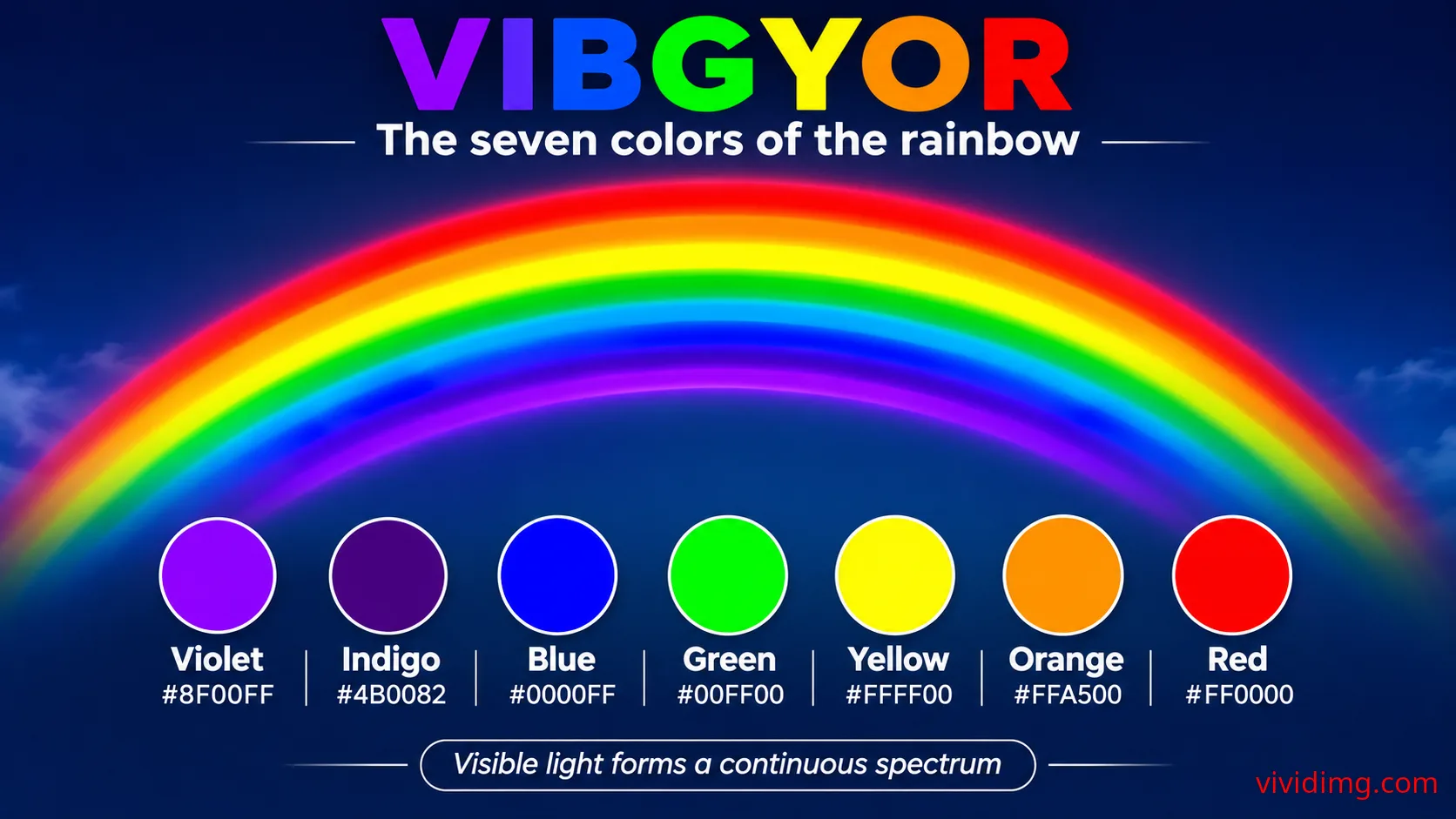
Yellow is the fifth color in the traditional VIBGYOR mnemonic, following violet, indigo, blue, and green and preceding orange and red.
The complete sequence is Violet, Indigo, Blue, Green, Yellow, Orange, and Red.
In a primary rainbow, yellow appears between green and orange. Natural rainbow colors transition continuously, so the boundaries between these named regions are gradual rather than sharply separated.
Yellow is especially important in color education because it connects spectral light, traditional primary colors, additive RGB mixing, subtractive printing, human visual sensitivity, and practical digital design.
Continue exploring the Color Backgrounds collection
This pure yellow reference belongs to the VividImg Color Backgrounds educational collection, which explores colors progressively from foundational concepts to advanced color relationships and creative applications.
The collection begins with an introduction to the VIBGYOR rainbow and neutral colors such as white, black, and gray. It then examines individual chromatic colors, their technical specifications, color families, shades, tints, tones, mixing methods, gradients, textures, and advanced color theory.
Pure yellow introduces essential concepts including RGB secondary colors, traditional RYB primary colors, additive light mixing, spectral wavelengths, relative luminance, complementary hues, and accessibility considerations.
Explore the Color Backgrounds collection on VividImg to discover educational color references, practical HEX and RGB codes, visually engaging backgrounds, and detailed explanations for students, teachers, designers, developers, photographers, and creative enthusiasts.
Image statistics
Loading statistics…Top 5 countries
— countries reached · all time
Country data will appear as views are recorded.
Daily views
Last 12 months
- —
- Unique visitors
- —
- Card clicks
- —
- Downloads
- —
- Share actions