Shareable Image
Brown color background with HEX code, RGB values and color meaning
Brown color background with HEX code, RGB values and color meaning
Brown color background with HEX code, RGB values and color meaning explores one of the most familiar and versatile earthy colors in nature, art, and digital design. Represented by the hexadecimal code #A52A2A, this particular shade is the standard CSS named color brown. It has a deep reddish-brown appearance created through a combination of red, green, and blue channel values. Brown is commonly associated with nature, soil, wood, stability, comfort, warmth, reliability, tradition, and simplicity.
This educational infographic features a rich reddish-brown background with a large white BROWN heading, an earth-color classification label, and a dark chocolate information panel. The panel displays a circular brown swatch, HEX and RGB values, HSL and HSV specifications, color family information, and an explanation of brown's relationship with darker and less luminous warm colors.
Brown is especially interesting in color science because it is not defined by one unique spectral wavelength. Brown perception depends strongly on lightness, surrounding colors, illumination, and visual context. Although many brown shades are related to dark orange or yellow-orange hues, the featured #A52A2A is specifically a reddish-brown color with a hue angle of 0° in the RGB-derived HSL model.
Understanding brown helps explain the relationship between color, brightness, saturation, material appearance, and human visual perception. It also introduces the important distinction between a color's digital code and the way that color appears in different visual environments.
What is brown?
Brown is a broad family of warm, relatively dark colors commonly associated with earth, wood, soil, leather, coffee, chocolate, and natural materials.
Many brown shades can be understood as darker, less luminous versions of orange, yellow-orange, or reddish-orange colors. However, brown is not restricted to one exact hue angle.
The specific shade featured in this infographic is #A52A2A, the standard CSS named color brown. Its RGB values are (165, 42, 42), giving it a distinctly reddish-brown appearance.
Because the green and blue channels have equal values, this particular brown lies on the red hue axis in the conventional RGB-derived HSL model. Its relatively low lightness and reduced saturation compared with pure red contribute to its darker, earthier appearance.
Brown is generally classified as a warm color, although cooler brown variations can occur when gray, blue, or violet undertones become more prominent.
Brown technical color specifications
Color name: Brown
Reference shade: CSS brown / reddish brown
HEX code: #A52A2A
RGB: (165, 42, 42)
HSL: Approximately (0°, 59%, 41%)
HSV / HSB: Approximately (0°, 75%, 65%)
CMYK: Approximately (0%, 75%, 75%, 35%) using a simplified mathematical conversion
Color family: Brown / red
Color classification: Earth color / chromatic color
Color temperature: Warm
HSL hue angle: 0°
HSL saturation: Approximately 59%
HSL lightness: Approximately 41%
HSV saturation: Approximately 75%
HSV value: Approximately 65%
Relative luminance: Approximately 0.098 in sRGB
Reference color space: sRGB
CSS color keyword: brown
Unique spectral wavelength: None
These values describe the specific digital color #A52A2A rather than every shade of brown. HSL and HSV values are rounded for readability. CMYK values are theoretical approximations, and actual printing results depend on ink characteristics, paper, printing technology, and color-management profiles.
Understanding the brown HEX code #A52A2A
Hexadecimal color notation is widely used in web development, graphic design, digital illustration, and image editing. A standard six-digit HEX color code contains three pairs of hexadecimal characters representing red, green, and blue channel intensities.
Each channel ranges from hexadecimal 00 to FF, corresponding to decimal values from 0 to 255.
In #A52A2A, the first pair A5 represents red at 165, the second pair 2A represents green at 42, and the final pair 2A represents blue at 42.
The stronger red contribution produces a reddish hue, while the relatively low green and blue values create a darker appearance than bright red.
Equivalent digital representations include:
HEX: #A52A2A
RGB: rgb(165, 42, 42)
HSL: approximately hsl(0, 59%, 41%)
HSV: approximately (0°, 75%, 65%)
CSS keyword: brown
These representations identify the same nominal color in the standard sRGB color space, with small differences possible when rounded HSL or HSV values are converted back into RGB.
How RGB screens create brown
RGB stands for Red, Green, and Blue. It is an additive color model used by computer monitors, smartphones, televisions, projectors, and other electronic displays.
In additive color mixing, red, green, and blue light combine at different intensities to produce a broad range of perceived colors.
For the featured brown #A52A2A, the red channel is 165, the green channel is 42, and the blue channel is 42.
The red channel is considerably stronger than the green and blue channels, producing a reddish appearance. However, the overall channel intensities are lower than those of pure red #FF0000, contributing to a darker result.
Brown perception also depends on visual context. A relatively dark orange or reddish-orange patch surrounded by lighter colors may appear brown, while the same patch in a different environment can appear more orange or red.
This relationship demonstrates why digital color codes describe channel values but do not completely determine how a color will be perceived under every viewing condition.
Why brown is considered an earth color
Brown is frequently described as an earth color because it resembles natural materials such as soil, clay, tree bark, wood, sand, rocks, leather, and dried leaves.
Earth colors are commonly associated with natural pigments and minerals, including iron oxides and various clay-based materials.
Traditional earth pigments include raw umber, burnt umber, raw sienna, and burnt sienna. These pigments can produce different brown, yellow-brown, and reddish-brown shades.
The featured #A52A2A is a digital reddish-brown reference rather than a direct measurement of any particular natural pigment.
Its warm appearance and connection with natural materials make it suitable for earthy visual themes, traditional artwork, rustic branding, and nature-inspired design.
Why brown has no single spectral wavelength
Visible light is electromagnetic radiation detectable by the human visual system. The visible spectrum is commonly described as extending approximately from 380 to 700 nanometers, although its exact boundaries depend on observing conditions and individual sensitivity.
Brown does not correspond to one unique monochromatic wavelength of visible light.
Instead, brown is a perceived color whose appearance depends on the spectral composition of light, overall luminance, surrounding colors, and visual context.
Many brown sensations are closely related to darker orange-family colors. Under different surrounding conditions, a color that appears brown may appear orange or reddish when viewed against a darker background.
The specific brown #A52A2A is a reddish-brown color, illustrating that brown can also include red-dominant hues.
This makes brown an important example of how human color perception involves more than simply assigning a wavelength to a color name.
Brown and the visible light spectrum
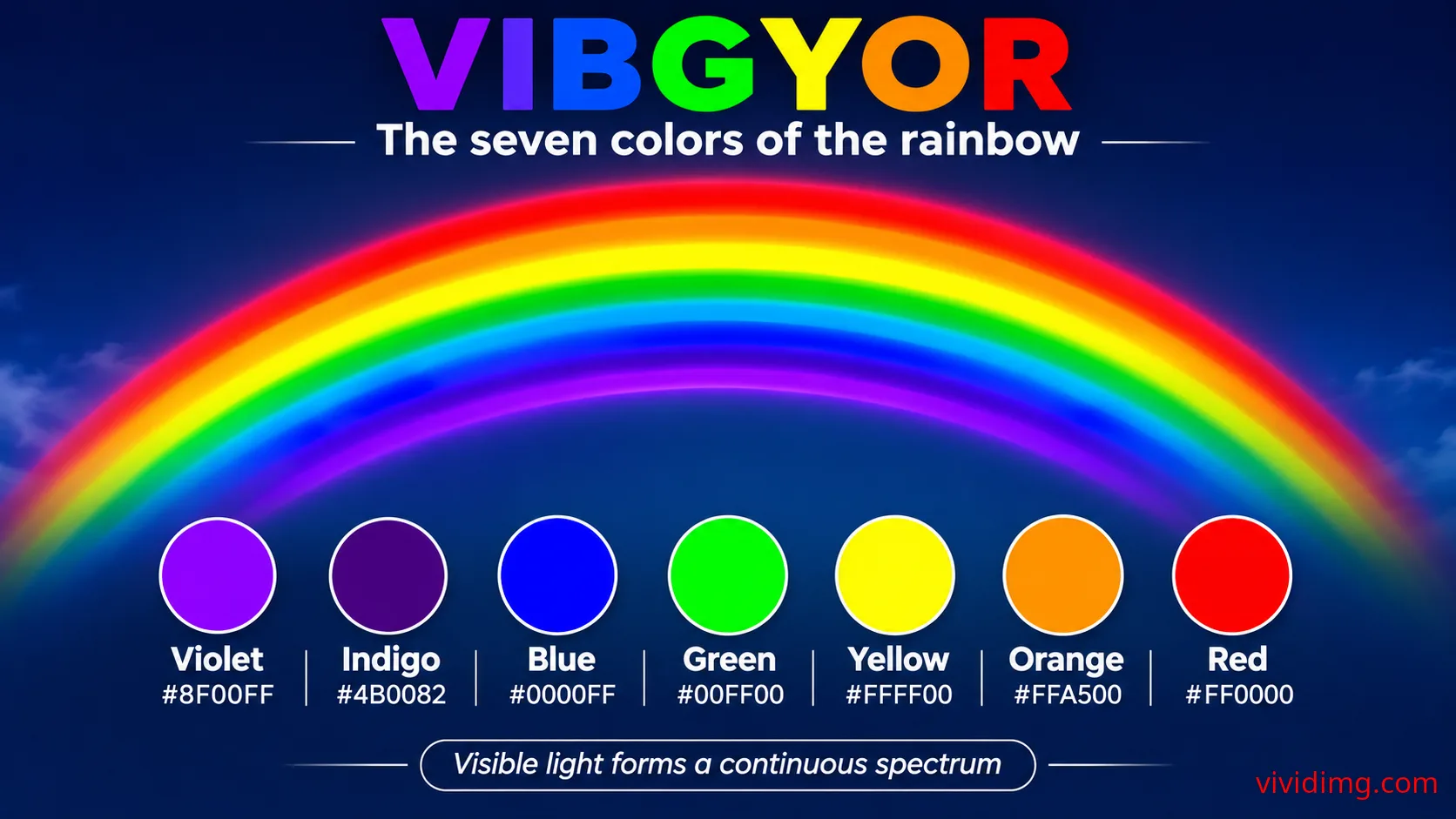
Brown is not traditionally included as a separate color in the seven-part VIBGYOR mnemonic.
The traditional sequence is Violet, Indigo, Blue, Green, Yellow, Orange, and Red.
Brown is related to combinations of color, lightness, and visual context rather than one distinct region of the visible spectrum.
Although many brown colors are associated with dark orange or yellow-orange hues, the featured CSS brown #A52A2A has a red hue angle in the RGB-derived HSL model.
Learning about brown after the traditional rainbow colors helps introduce darker chromatic colors, earth tones, contextual color perception, and the distinction between hue and lightness.
Brown in the HSL color model
HSL stands for Hue, Saturation, and Lightness. Hue identifies a position around the RGB-derived color wheel, saturation describes color intensity within the HSL model, and lightness represents the position between black and white.
Brown #A52A2A has an approximate HSL representation of (0°, 59%, 41%).
The hue angle of 0° identifies the red direction on the conventional RGB color wheel. The saturation value of approximately 59% indicates a less saturated appearance than pure red, while the lightness value of approximately 41% contributes to the darker visual character.
HSL lightness is not equivalent to physical luminance or perceived brightness. Colors with the same HSL lightness can appear different in brightness because human vision responds differently to different colors.
The HSL representation helps explain why this specific brown is more accurately described as reddish brown rather than a conventional dark orange hue.
Brown in the HSV and HSB color models
HSV stands for Hue, Saturation, and Value. HSB uses brightness instead of value but refers to the same general model.
Brown #A52A2A has an approximate HSV representation of (0°, 75%, 65%).
Its hue is 0°, saturation is approximately 75%, and value is approximately 65%.
The HSV value reflects the maximum RGB channel intensity relative to its possible maximum of 255.
Because the red channel is 165 rather than 255, the HSV value is approximately 65%.
HSL and HSV are useful for selecting and adjusting digital colors, but neither model is perceptually uniform.
Brown color temperature and visual characteristics
Brown is generally classified as a warm color because of its associations with earth, wood, autumn leaves, natural materials, and warm interior environments.
Warm brown shades often contain red, orange, or yellow undertones, while cooler brown shades may include gray, blue, or violet undertones.
The featured #A52A2A has a strong reddish character, creating a rich and grounded appearance.
Brown is often perceived as less visually intense than bright red, orange, or yellow, making it useful for earthy backgrounds and natural design themes.
Brown can be combined with cream, beige, ivory, gold, olive, forest green, teal, and neutral colors to create balanced visual compositions.
Brown color psychology and symbolism
Brown is commonly associated with stability, reliability, comfort, warmth, nature, simplicity, tradition, and groundedness.
Its visual relationship with soil, wood, leather, and natural materials often makes it suitable for rustic, organic, and heritage-inspired designs.
Brown can also communicate durability, practicality, craftsmanship, and familiarity.
In some contexts, dark brown may appear serious or conservative, while lighter brown shades can feel softer and more welcoming.
These associations depend on culture, context, personal experience, and surrounding visual elements. Color psychology should be understood as a collection of common associations rather than universal scientific rules.
Popular shades and variations of brown
The brown color family includes light, dark, reddish, yellowish, muted, and earthy variations.
Representative digital brown-family shades include:
Brown: #A52A2A
Saddle brown: #8B4513
Sienna: #A0522D
Chocolate: #D2691E
Peru: #CD853F
Sandy brown: #F4A460
Rosy brown: #BC8F8F
Tan: #D2B48C
Burlywood: #DEB887
Wheat: #F5DEB3
Dark goldenrod: #B8860B
Goldenrod: #DAA520
Maroon: #800000
Dark red: #8B0000
These examples demonstrate how brown-family colors can vary in hue, saturation, and lightness. The featured infographic uses CSS brown #A52A2A as its primary digital reference.
Brown color combinations and matching palettes
Brown can be combined with neutral colors, warm earth tones, cool contrasting colors, and natural green shades.
Useful brown combinations include:
Brown and cream: #A52A2A + #FFFDD0 — Warm traditional appearance
Brown and beige: #A52A2A + #F5F5DC — Soft earthy palette
Brown and ivory: #A52A2A + #FFFFF0 — Elegant neutral contrast
Brown and white: #A52A2A + #FFFFFF — Clean readable combination
Brown and black: #A52A2A + #000000 — Dark dramatic styling
Brown and gold: #A52A2A + #FFD700 — Rich decorative palette
Brown and olive: #A52A2A + #808000 — Natural earth-inspired combination
Brown and forest green: #A52A2A + #228B22 — Woodland-inspired palette
Brown and teal: #A52A2A + #008080 — Warm-cool contrast
Brown and light blue: #A52A2A + #ADD8E6 — Balanced contemporary styling
Brown and tan: #A52A2A + #D2B48C — Coordinated monochromatic-style palette
These are visual palette suggestions rather than physical pigment-mixing equations. Their effectiveness depends on color proportions, typography, contrast, and surrounding design elements.
What is the complementary color of brown?
The complementary color of brown depends on the specific brown shade and the color model being used.
Many orange-brown shades have blue-family complementary hues on conventional color wheels.
However, the featured CSS brown #A52A2A has an HSL hue angle of 0°, corresponding to the red direction. Its hue-opposite position on the RGB-derived HSL wheel is 180°, corresponding to cyan.
An approximate HSL hue-opposite color for #A52A2A is #2AA5A5 when preserving the original saturation and lightness.
This illustrates why the complementary color of a named color family cannot always be identified without specifying its exact digital reference.
Brown in traditional pigment mixing
Brown pigments can be produced using natural earth materials or by mixing different pigments.
In traditional painting, brown-family colors may be created by combining complementary pigments, mixing multiple primary colors, or darkening orange-family mixtures.
For example, adding a suitable blue pigment to orange paint can produce muted brown-family mixtures, depending on pigment characteristics and proportions.
Natural brown pigments such as umber and sienna have been used in painting and decorative arts for centuries.
Actual pigment mixing depends on spectral absorption, transparency, pigment concentration, and the materials involved.
This differs from RGB digital color creation, where brown is represented by specific red, green, and blue channel values.
Accessibility and text contrast on brown backgrounds
Brown #A52A2A has an approximate relative luminance of 0.098 in the sRGB color space.
Its contrast ratio against pure white #FFFFFF is approximately 7.08:1. Against pure black #000000, the contrast ratio is approximately 2.97:1.
Under WCAG 2.x AA criteria, normal text generally requires a minimum contrast ratio of 4.5:1, while large text generally requires at least 3:1.
White text on the featured brown background meets the AA requirement for both normal and large text. Black text does not meet the AA contrast requirement for normal text and falls slightly below the 3:1 threshold for large text.
This makes white or very light typography a better choice for text placed directly on the featured brown background.
The infographic follows this principle by using large white typography against the reddish-brown background and placing smaller technical information inside a darker chocolate panel.
Important information should not rely on color alone. Clear labels, icons, and additional visual indicators help improve accessibility.
Using brown in websites and user interface design
Brown is widely used in websites and applications for natural themes, rustic branding, traditional products, coffee-related businesses, food websites, furniture catalogs, lifestyle platforms, and educational graphics.
The featured #A52A2A is relatively dark, making it suitable for backgrounds paired with light typography.
Brown can be combined with cream, beige, ivory, and warm neutral colors to create comfortable reading environments and visually grounded layouts.
In modern interface design, brown may also be used as an accent color for buttons, cards, banners, and decorative elements.
When designing interactive components, developers should verify text contrast, focus indicators, hover states, and overall visual hierarchy.
CSS examples for brown backgrounds
Web developers can recreate the featured brown using hexadecimal notation, RGB values, HSL values, or the predefined CSS keyword brown.
/* Brown background */
.brown-background {
  background-color: #A52A2A;
  color: #FFFFFF;
}

/* Equivalent RGB representation */
.brown-rgb {
  background-color: rgb(165, 42, 42);
}

/* Approximate HSL representation */
.brown-hsl {
  background-color: hsl(0, 59%, 41%);
}

/* CSS named color */
.brown-keyword {
  background-color: brown;
}

/* Reusable CSS variables */
:root {
  --color-brown: #A52A2A;
  --color-saddle-brown: #8B4513;
  --color-sienna: #A0522D;
  --color-tan: #D2B48C;
  --color-cream: #FFFDD0;
  --color-white: #FFFFFF;
}

.brown-panel {
  background-color: var(--color-brown);
  color: var(--color-white);
}

/* Decorative brown gradient */
.brown-gradient {
  background: linear-gradient(
    135deg,
    #8B4513 0%,
    #A52A2A 55%,
    #D2B48C 100%
  );
}
The gradient example demonstrates a possible creative application using saddle brown, CSS brown, and tan. It is separate from the solid brown background shown in the educational infographic.
Brown in nature, photography and everyday life
Brown appears throughout nature in soil, wood, tree bark, rocks, dried leaves, coffee beans, cocoa, leather, and many other materials.
These objects display brown because of pigments, surface structures, illumination, and interactions with visible light.
In photography, brown is frequently used to create earthy compositions, autumn landscapes, rustic scenes, warm portraits, and natural textures.
In fashion, brown appears in traditional garments, leather accessories, footwear, casual clothing, and seasonal collections. Light brown and tan provide softer alternatives, while chocolate and dark brown offer deeper appearances.
In interior design, brown is commonly used in wooden furniture, flooring, textiles, wall finishes, decorative objects, and natural-material themes.
Brown in branding, packaging and digital media
Brown is frequently used in branding for coffee, chocolate, furniture, handmade goods, natural products, traditional crafts, and rustic lifestyle businesses.
Its associations with earth and natural materials can communicate simplicity, craftsmanship, familiarity, and warmth.
Brown also works well in packaging designs that emphasize natural textures, organic themes, or traditional visual identities.
In digital media, brown can be combined with beige, cream, gold, olive, and forest green to create coordinated earth-tone palettes.
Its versatility makes it suitable for both subtle background treatments and expressive visual accents.
Understanding the brown educational infographic
The image features a rich reddish-brown background representing #A52A2A. A large white BROWN heading appears near the upper-left corner, followed by a white underline and a rounded dark classification label reading Earth color / warm color family.
A wide dark chocolate information panel occupies the lower-left and central portion of the composition. On the left, a circular brown swatch outlined in white identifies the featured color.
The central specification section displays HEX #A52A2A, RGB (165, 42, 42), HSL approximately (0°, 59%, 41%), HSV approximately (0°, 75%, 65%), the brown/red color family, and warm temperature classification.
On the right, a bordered statement describes brown as a dark, muted orange-red color. This is a broad educational description of many brown-family appearances; the featured #A52A2A specifically has a red hue angle in the RGB-derived HSL model.
A supporting explanation states that brown has no single spectral wavelength and that its appearance depends on color and surrounding context.
The composition preserves a large uninterrupted brown area above the information panel, allowing viewers to appreciate the featured color directly while keeping the technical information organized.
The infographic focuses exclusively on brown and its relevant scientific and digital properties without adding lesson numbers, unrelated decorative graphics, or unnecessary visual elements.
Brown and its relationship with VIBGYOR
Brown is not traditionally listed as a separate color in the seven-part VIBGYOR mnemonic.
The traditional sequence is Violet, Indigo, Blue, Green, Yellow, Orange, and Red.
Brown belongs to a broad family of darker earth tones rather than one unique spectral color region.
Its appearance is influenced by hue, saturation, lightness, and visual context.
Learning about brown after the traditional VIBGYOR colors helps introduce earth colors, darker chromatic shades, contextual color perception, and the relationship between digital color values and natural materials.
Continue exploring the Color Backgrounds collection
This brown color reference belongs to the VividImg Color Backgrounds educational collection, which explores colors progressively from foundational concepts to advanced color relationships and creative applications.
The collection begins with an introduction to the VIBGYOR rainbow and neutral colors such as white, black, and gray. It then examines additional individual chromatic colors, including cyan, magenta, pink, brown, maroon, olive, teal, navy, and other useful digital color references.
Future topics include shades, tints, tones, two-color and three-color mixing, complementary palettes, analogous color harmonies, gradients, textures, accessibility, and advanced color theory.
Brown introduces essential concepts including earth colors, reddish-brown digital values, contextual color perception, natural pigments, color psychology, complementary hues, relative luminance, accessibility, and nature-inspired design applications.
Explore the Color Backgrounds collection on VividImg to discover educational color references, practical HEX and RGB codes, visually engaging backgrounds, and detailed explanations for students, teachers, designers, developers, photographers, and creative enthusiasts.
Image statistics
Loading statistics…Top 5 countries
— countries reached · all time
Country data will appear as views are recorded.
Daily views
Last 12 months
- —
- Unique visitors
- —
- Card clicks
- —
- Downloads
- —
- Share actions