Shareable Image
Olive green color background with HEX code, RGB values and color meaning
Olive green color background with HEX code, RGB values and color meaning
Olive green color background with HEX code, RGB values and color meaning explores one of the most distinctive earthy colors in the yellow-green family. Represented by the hexadecimal code #808000, olive is a dark yellow-green color produced on RGB displays using equal red and green channel values with no blue contribution. Its subdued appearance makes it a popular choice for nature-inspired artwork, traditional designs, military-style palettes, fashion, interior decoration, digital backgrounds, and educational color references.
This educational infographic features a rich olive-green background with a large white OLIVE heading, a yellow-green classification label, and a dark olive information panel. The panel displays a circular olive swatch, HEX and RGB values, HSL and HSV specifications, color family information, and an explanation of how digital screens produce olive using red and green light.
Olive is commonly associated with nature, stability, resilience, simplicity, tradition, harmony, practicality, and understated elegance. Its muted yellow-green appearance makes it useful for designs that require a natural or earthy visual identity without the brightness of pure yellow or green.
Understanding olive introduces important concepts in digital color theory, including darker color variations, additive RGB mixing, HSL lightness, HSV value, complementary colors, relative luminance, accessibility, and the relationship between digital color values and natural materials.
What is olive green?
Olive is a dark yellow-green color named after the characteristic appearance of many olives and olive-related natural tones.
The specific shade featured in this infographic is #808000, the standard CSS named color olive.
Its RGB values are (128, 128, 0), meaning red and green are present at equal encoded channel values while blue is absent.
In the RGB-derived HSL color model, olive has a hue angle of 60°, the same nominal hue direction as pure yellow #FFFF00. Its darker appearance results from lower channel intensities and reduced lightness.
Olive is therefore an excellent example of a darker yellow-family color that is commonly perceived as yellow-green or earthy green.
Olive is generally described as a warm earthy color, although its perceived temperature depends on the surrounding palette. Yellow-dominant olive shades often appear warmer, while greener or grayish olive shades can appear cooler.
Olive technical color specifications
Color name: Olive
Reference shade: CSS olive / dark yellow-green
HEX code: #808000
RGB: (128, 128, 0)
HSL: Approximately (60°, 100%, 25%)
HSV / HSB: Approximately (60°, 100%, 50%)
CMYK: Approximately (0%, 0%, 100%, 50%) using a simplified mathematical conversion
Color family: Olive / yellow-green
Color classification: Dark yellow-green / earthy color
Color temperature: Warm earthy
HSL hue angle: 60°
HSL saturation: 100%
HSL lightness: Approximately 25%
HSV saturation: 100%
HSV value: Approximately 50%
Relative luminance: Approximately 0.2003 in sRGB
Reference color space: sRGB
CSS color keyword: olive
Primary RGB contributions: Red and green
These specifications describe the particular digital color #808000 rather than every shade in the olive family. HSL and HSV values are rounded for readability. CMYK values are theoretical approximations, and actual printed results depend on ink characteristics, paper, printing technology, and color-management profiles.
Understanding the olive HEX code #808000
Hexadecimal color notation is widely used in web development, graphic design, image editing, and digital illustration. A standard six-digit HEX color code contains three pairs of hexadecimal characters representing red, green, and blue channel intensities.
Each channel ranges from hexadecimal 00 to FF, corresponding to decimal values from 0 to 255.
In #808000, the first pair 80 represents red at 128, the second pair 80 represents green at 128, and the final pair 00 represents blue at zero.
The equal red and green contributions create a yellow hue in the RGB model, while their reduced channel values produce a darker appearance commonly recognized as olive.
Equivalent digital representations include:
HEX: #808000
RGB: rgb(128, 128, 0)
HSL: approximately hsl(60, 100%, 25%)
HSV: approximately (60°, 100%, 50%)
CSS keyword: olive
These representations identify the same nominal color within the standard sRGB color space, with small differences possible when rounded HSL or HSV values are converted back into RGB.
How RGB screens create olive
RGB stands for Red, Green, and Blue. It is an additive color model used by computer monitors, smartphones, televisions, projectors, and other electronic displays.
In additive color mixing, red, green, and blue light combine at different intensities to produce a broad range of perceived colors.
For olive #808000, the red channel is 128, the green channel is 128, and the blue channel is zero.
Pure yellow #FFFF00 uses maximum red and green channel values of 255 with zero blue. Olive uses lower values of 128 for both red and green.
This produces a darker yellow hue that is commonly described as olive green.
Although 128 is approximately half the maximum encoded RGB channel value of 255, it does not correspond to exactly half the physical light output because standard sRGB values are gamma-encoded.
The infographic illustrates the underlying RGB relationship by explaining that olive uses equal red and green contributions without blue.
Why olive is a dark yellow-green color
Olive is commonly described as yellow-green because of its earthy visual appearance and association with natural olive-colored materials.
However, the exact digital shade #808000 has an HSL hue angle of 60°, corresponding to the yellow direction of the conventional RGB color wheel.
Its darker appearance comes from lower RGB channel values and lower HSL lightness compared with pure yellow.
Pure yellow #FFFF00 has HSL lightness of 50%, while olive #808000 has HSL lightness of approximately 25%.
This demonstrates how reducing lightness can transform a bright yellow color into a darker appearance perceived as olive.
Other olive-green shades may have hue angles closer to green, creating a stronger green appearance than the CSS reference #808000.
Olive and the visible light spectrum
Visible light is electromagnetic radiation detectable by the human visual system. The visible spectrum is commonly described as extending approximately from 380 to 700 nanometers, although the precise limits depend on observing conditions and individual sensitivity.
The exact digital olive color #808000 does not correspond to one unique monochromatic wavelength.
On an RGB display, olive is produced by combining red and green display primaries at reduced channel values.
The resulting appearance depends on the display's spectral characteristics, viewing conditions, and human color perception.
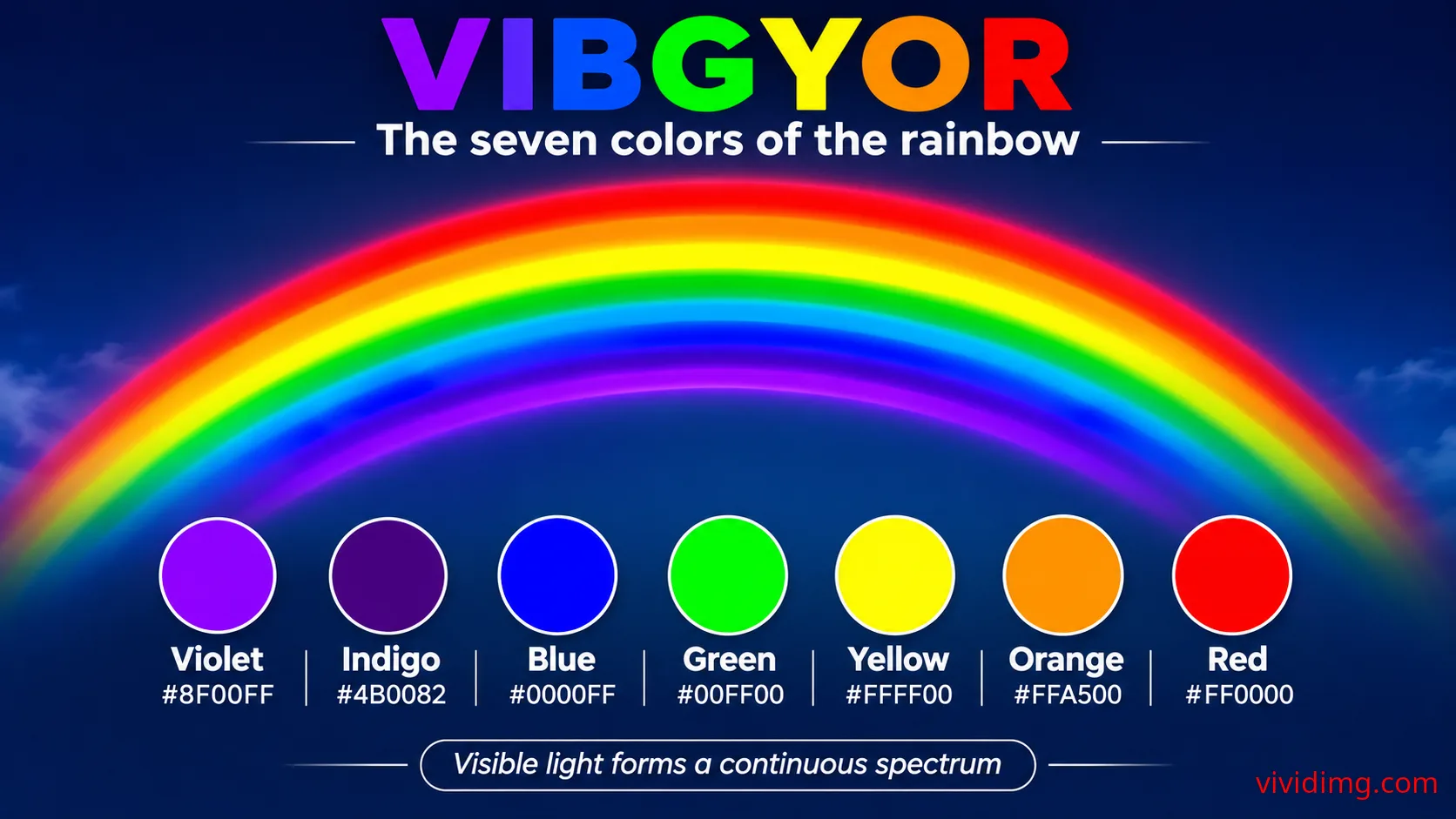
Olive is not traditionally listed as a separate color in the seven-part VIBGYOR mnemonic.
Instead, it is understood as a darker variation related to the yellow and green color families.
Olive in the HSL color model
HSL stands for Hue, Saturation, and Lightness. Hue identifies a position around the RGB-derived color wheel, saturation describes color intensity within the HSL model, and lightness represents the position between black and white.
Olive #808000 has an approximate HSL representation of (60°, 100%, 25%).
The hue angle of 60° identifies the yellow direction on the conventional RGB color wheel.
The saturation value of 100% indicates maximum HSL saturation for the given hue and lightness.
The lightness value of approximately 25% explains why olive appears substantially darker than pure yellow.
HSL lightness is not equivalent to physical luminance or perceived brightness. Colors with identical HSL lightness values can appear different in brightness because human vision responds differently to different color combinations.
Olive in the HSV and HSB color models
HSV stands for Hue, Saturation, and Value. HSB uses brightness instead of value but refers to the same general model.
Olive #808000 has an approximate HSV representation of (60°, 100%, 50%).
Its hue is 60°, saturation is 100%, and value is approximately 50%.
The HSV value reflects the maximum RGB channel value relative to its possible maximum of 255.
Because the red and green channels are both 128, the HSV value is approximately 50%.
HSL and HSV are convenient for selecting and adjusting digital colors, but neither model is perceptually uniform.
Olive color temperature and visual characteristics
Olive is commonly classified as a warm earthy color because of its yellow component and natural associations.
Its muted appearance creates a sense of visual stability and makes it suitable for rustic, nature-inspired, traditional, and understated compositions.
Olive can be used as an alternative to bright green or yellow when a design requires a less intense appearance.
It combines effectively with cream, beige, ivory, tan, brown, charcoal, navy, rust, and muted orange.
Olive may appear warmer or cooler depending on its undertones. Yellow-dominant olive shades often feel warmer, while gray-green or blue-green olive variations may feel cooler.
Olive color psychology and symbolism
Olive is commonly associated with nature, stability, resilience, harmony, practicality, simplicity, tradition, and groundedness.
Its visual relationship with vegetation, natural materials, and earth tones makes it suitable for organic, rustic, and environmentally inspired designs.
Olive is also associated with military-style clothing, outdoor equipment, traditional fashion, and durable materials.
In some contexts, olive can communicate calmness, maturity, reliability, or understated confidence.
These associations depend on culture, context, personal experience, and surrounding visual elements. Color psychology should be understood as a collection of common associations rather than universal scientific rules.
Popular shades and variations of olive
The olive color family includes dark, light, yellowish, greenish, grayish, and muted variations.
Representative digital olive-related shades include:
Olive: #808000
Dark olive green: #556B2F
Olive drab: #6B8E23
Yellow green: #9ACD32
Dark khaki: #BDB76B
Khaki: #F0E68C
Dark goldenrod: #B8860B
Goldenrod: #DAA520
Forest green: #228B22
Dark green: #006400
Sea green: #2E8B57
Sage green: #9CAF88
Army green: #4B5320
Moss green: #8A9A5B
These examples demonstrate how olive-family colors can vary in hue, saturation, and lightness. The featured infographic uses pure CSS olive #808000 as its primary digital reference.
Olive versus army green, khaki and moss green
Olive, army green, khaki, and moss green are related earthy color names, but they do not always represent identical digital colors.
Olive generally refers to a dark yellow-green shade and is represented by #808000 in standard CSS color naming.
Army green commonly describes a dark, muted green associated with military-style clothing and equipment. Its exact HEX code varies across design systems.
Khaki usually refers to a muted yellow-brown or beige-green family, depending on the particular shade and regional naming conventions.
Moss green generally describes a muted natural green inspired by moss and vegetation.
When accurate color reproduction matters, designers should use explicit HEX or RGB values rather than relying only on descriptive color names.
Olive color combinations and matching palettes
Olive can be combined with neutral colors, warm earth tones, natural greens, and contrasting cool accents.
Useful olive combinations include:
Olive and white: #808000 + #FFFFFF — Clean natural contrast
Olive and cream: #808000 + #FFFDD0 — Warm earthy appearance
Olive and ivory: #808000 + #FFFFF0 — Soft traditional palette
Olive and beige: #808000 + #F5F5DC — Balanced neutral combination
Olive and brown: #808000 + #A52A2A — Rustic earth-tone styling
Olive and tan: #808000 + #D2B48C — Coordinated natural palette
Olive and black: #808000 + #000000 — Dark dramatic combination
Olive and charcoal: #808000 + #36454F — Contemporary muted palette
Olive and navy: #808000 + #001F3F — Sophisticated cool-warm balance
Olive and rust: #808000 + #B7410E — Autumn-inspired palette
Olive and gold: #808000 + #FFD700 — Rich decorative styling
Olive and lavender: #808000 + #E6E6FA — Soft contrasting color combination
These are visual palette suggestions rather than physical pigment-mixing equations. Their effectiveness depends on color proportions, typography, contrast, and surrounding design elements.
What is the complementary color of olive?
In the conventional RGB-derived HSL color wheel, olive #808000 has a hue angle of 60°. Its complementary hue lies 180° opposite, corresponding to 240°, the blue direction.
An approximate HSL hue-opposite digital reference is #000080, commonly known as navy, when preserving the original saturation and lightness.
This makes olive and navy a useful complementary-style combination for digital designs.
However, complementary relationships depend on the color model being used. Traditional RYB color wheels may produce different complementary relationships.
The exact complementary shade should therefore be selected according to the intended color model and design context.
Olive in traditional pigment mixing
In traditional painting, olive-family colors can be produced by mixing yellow and green pigments with suitable darkening or muting colors.
Adding small amounts of black, brown, or complementary pigments to yellow-green mixtures can create darker earthy shades, depending on the pigments involved.
Natural earth pigments and mineral-based colorants can also contribute to olive-like appearances in painting and decorative arts.
Actual pigment mixing depends on spectral absorption, transparency, pigment concentration, and the materials involved.
This differs from RGB digital color creation, where olive #808000 is represented by equal red and green channel values with zero blue.
Accessibility and text contrast on olive backgrounds
Olive #808000 has an approximate relative luminance of 0.2003 in the sRGB color space.
Its contrast ratio against pure white #FFFFFF is approximately 4.20:1. Against pure black #000000, the contrast ratio is approximately 5.01:1.
Under WCAG 2.x AA criteria, normal text generally requires a minimum contrast ratio of 4.5:1, while large text generally requires at least 3:1.
Black text on olive meets the AA requirement for normal and large text. White text on olive meets the AA requirement for large text but falls below the 4.5:1 threshold for normal-sized text.
This makes black or very dark typography a stronger choice for smaller text placed directly on the featured olive background.
The infographic uses large white typography for the OLIVE heading and places smaller technical information inside a dark olive panel for clearer visual separation.
Important information should not rely on color alone. Clear labels, icons, and additional visual indicators help improve accessibility.
Using olive in websites and user interface design
Olive is widely used in websites and applications for nature-inspired branding, outdoor products, traditional fashion, organic themes, military-style palettes, lifestyle platforms, and educational graphics.
The featured #808000 is moderately dark, making it suitable for backgrounds when paired with carefully selected contrasting typography.
Olive can be combined with cream, beige, ivory, tan, and other warm neutral colors to create visually comfortable layouts.
In modern interface design, olive may also be used as an accent color for buttons, cards, banners, navigation elements, and selected decorative details.
When designing interactive components, developers should verify text contrast, focus indicators, hover states, and overall visual hierarchy.
CSS examples for olive backgrounds
Web developers can recreate the featured olive using hexadecimal notation, RGB values, HSL values, or the predefined CSS keyword olive.
/* Olive background */
.olive-background {
  background-color: #808000;
  color: #000000;
}

/* Equivalent RGB representation */
.olive-rgb {
  background-color: rgb(128, 128, 0);
}

/* Approximate HSL representation */
.olive-hsl {
  background-color: hsl(60, 100%, 25%);
}

/* CSS named color */
.olive-keyword {
  background-color: olive;
}

/* Reusable CSS variables */
:root {
  --color-olive: #808000;
  --color-dark-olive: #556B2F;
  --color-olive-drab: #6B8E23;
  --color-cream: #FFFDD0;
  --color-tan: #D2B48C;
  --color-white: #FFFFFF;
}

.olive-panel {
  background-color: var(--color-olive);
  color: #000000;
}

/* Decorative olive gradient */
.olive-gradient {
  background: linear-gradient(
    135deg,
    #556B2F 0%,
    #808000 55%,
    #BDB76B 100%
  );
}
The gradient example demonstrates a possible creative application using dark olive green, CSS olive, and dark khaki. It is separate from the solid olive background shown in the educational infographic.
Olive in nature, photography and everyday life
Olive-like colors appear throughout nature in olives, leaves, grasses, moss, vegetation, soil-related materials, and seasonal landscapes.
These objects display olive-family colors because of pigments, surface structures, illumination, and interactions with visible light.
In photography, olive is frequently used to create earthy compositions, woodland themes, outdoor scenes, rustic portraits, and natural textures.
In fashion, olive appears in casual clothing, jackets, trousers, sarees, blouses, accessories, and outdoor-inspired collections. Dark olive creates a strong grounded appearance, while lighter olive and sage shades offer softer alternatives.
In interior design, olive is commonly used in upholstery, wall accents, curtains, furniture finishes, decorative objects, and nature-inspired color palettes.
Olive in branding, packaging and digital media
Olive is frequently used in branding for outdoor products, natural materials, organic-inspired goods, traditional crafts, lifestyle businesses, and nature-related services.
Its earthy appearance can communicate simplicity, durability, practicality, stability, and a connection with nature.
Olive works particularly well with cream, beige, tan, brown, and muted gold accents in packaging and promotional materials.
In digital media, olive can be combined with modern neutral colors to create coordinated website layouts, presentation backgrounds, and social media graphics.
Its versatility makes it useful for both full-background designs and smaller decorative elements.
Understanding the olive educational infographic
The image features a rich olive-green background representing #808000. A large white OLIVE heading appears near the upper-left corner, followed by a white underline and a rounded dark classification label reading Yellow-green family / warm earthy color.
A wide dark olive information panel occupies the lower-left and central portion of the composition. On the left, a circular olive swatch outlined in white identifies the featured color.
The central specification section displays HEX #808000, RGB (128, 128, 0), HSL (60°, 100%, 25%), HSV (60°, 100%, 50%), the olive/yellow-green color family, and warm earthy temperature classification.
On the right, a bordered statement explains that olive is a dark yellow-green color. A supporting explanation states that RGB screens create olive using equal red and green channel values without blue.
The composition preserves a large uninterrupted olive area above the information panel, allowing viewers to appreciate the featured color directly while keeping the technical information organized.
The infographic focuses exclusively on olive and its relevant digital color properties without adding lesson numbers, unrelated decorative graphics, or unnecessary visual elements.
Olive and its relationship with VIBGYOR
Olive is not traditionally listed as a separate color in the seven-part VIBGYOR mnemonic.
The traditional sequence is Violet, Indigo, Blue, Green, Yellow, Orange, and Red.
Olive belongs to the yellow-green color family and represents a darker earthy variation rather than a separate spectral color category.
Its appearance demonstrates how changing RGB channel intensity and lightness can create darker variations of familiar colors.
Learning about olive after the traditional VIBGYOR colors helps introduce earth tones, dark yellow-green variations, RGB color mixing, HSL lightness, HSV value, and practical color contrast.
Continue exploring the Color Backgrounds collection
This olive color reference belongs to the VividImg Color Backgrounds educational collection, which explores colors progressively from foundational concepts to advanced color relationships and creative applications.
The collection begins with an introduction to the VIBGYOR rainbow and neutral colors such as white, black, and gray. It then examines additional individual chromatic colors, including cyan, magenta, pink, brown, maroon, olive, teal, navy, and other useful digital color references.
Future topics include shades, tints, tones, two-color and three-color mixing, complementary palettes, analogous color harmonies, gradients, textures, accessibility, and advanced color theory.
Olive introduces essential concepts including dark yellow-green colors, RGB channel intensity, HSL lightness, HSV value, color psychology, complementary hues, relative luminance, accessibility, and earthy design applications.
Explore the Color Backgrounds collection on VividImg to discover educational color references, practical HEX and RGB codes, visually engaging backgrounds, and detailed explanations for students, teachers, designers, developers, photographers, and creative enthusiasts.
Image statistics
Loading statistics…Top 5 countries
— countries reached · all time
Country data will appear as views are recorded.
Daily views
Last 12 months
- —
- Unique visitors
- —
- Card clicks
- —
- Downloads
- —
- Share actions