Shareable Image
Navy blue color background with HEX code, RGB values and color meaning
Navy blue color background with HEX code, RGB values and color meaning
Navy blue color background with HEX code, RGB values and color meaning explores one of the most elegant, recognizable, and versatile dark shades in the blue color family. Represented by the hexadecimal code #000080, standard digital navy is created using a reduced blue RGB channel value without any red or green contribution. Its deep appearance makes it a popular choice for professional branding, corporate websites, traditional clothing, fashion collections, educational graphics, interior decoration, and digital artwork.
This educational infographic features a rich navy blue background with a large white NAVY heading, a classification label identifying navy as a dark blue shade belonging to the cool color family, and a darker navy information panel. The panel displays a circular navy swatch, HEX and RGB values, HSL and HSV specifications, color family information, and an explanation of how RGB screens produce navy blue.
Navy blue is commonly associated with professionalism, trust, authority, intelligence, discipline, stability, confidence, and sophistication. Its restrained appearance makes it suitable for formal and professional compositions that require a darker alternative to bright blue.
Understanding navy blue introduces important concepts in digital color theory, including RGB channel intensity, darker color shades, HSL lightness, HSV value, relative luminance, complementary colors, accessibility, and practical color combinations.
What is navy blue?
Navy blue is a deep, dark shade belonging to the blue color family. Its name is historically associated with the dark blue uniforms worn by naval officers, particularly those of the British Royal Navy.
The specific shade featured in this infographic is #000080, the standard CSS named color navy.
Its RGB values are (0, 0, 128), meaning the blue channel has a value of 128 while the red and green channels remain at zero.
In the RGB-derived HSL color model, navy has a hue angle of 240°, the same nominal hue direction as pure blue #0000FF. Its darker appearance results from lower channel intensity and reduced lightness.
Navy is generally classified as a cool color because of its relationship with blue. However, different navy-family shades can contain green, gray, or violet undertones that influence their perceived temperature and appearance.
Navy blue technical color specifications
Color name: Navy
Reference shade: CSS navy / navy blue
HEX code: #000080
RGB: (0, 0, 128)
HSL: Approximately (240°, 100%, 25%)
HSV / HSB: Approximately (240°, 100%, 50%)
CMYK: Approximately (100%, 100%, 0%, 50%) using a simplified mathematical conversion
Color family: Blue
Color classification: Dark blue shade / chromatic color
Color temperature: Cool
HSL hue angle: 240°
HSL saturation: 100%
HSL lightness: Approximately 25%
HSV saturation: 100%
HSV value: Approximately 50%
Relative luminance: Approximately 0.0156 in sRGB
Reference color space: sRGB
CSS color keyword: navy
Primary RGB contribution: Blue
These specifications describe the particular digital color #000080 rather than every shade in the navy blue family. HSL and HSV values are rounded for readability. CMYK values are theoretical approximations, and actual printed results depend on ink characteristics, paper, printing technology, and color-management profiles.
Understanding the navy blue HEX code #000080
Hexadecimal color notation is widely used in web development, graphic design, image editing, and digital illustration. A standard six-digit HEX color code contains three pairs of hexadecimal characters representing red, green, and blue channel intensities.
Each channel ranges from hexadecimal 00 to FF, corresponding to decimal values from 0 to 255.
In #000080, the first pair 00 represents red at zero, the second pair 00 represents green at zero, and the final pair 80 represents blue at 128.
The absence of red and green contributions places this color on the blue hue axis, while the reduced blue channel value creates its dark appearance.
Equivalent digital representations include:
HEX: #000080
RGB: rgb(0, 0, 128)
HSL: approximately hsl(240, 100%, 25%)
HSV: approximately (240°, 100%, 50%)
CSS keyword: navy
These representations identify the same nominal color within the standard sRGB color space, with small differences possible when rounded HSL or HSV values are converted back into RGB.
How RGB screens create navy blue
RGB stands for Red, Green, and Blue. It is an additive color model used by computer monitors, smartphones, televisions, projectors, and other electronic displays.
In additive color mixing, red, green, and blue light combine at different intensities to produce a broad range of perceived colors.
For navy #000080, the red channel is zero, the green channel is zero, and the blue channel is 128.
Pure blue #0000FF uses the maximum blue channel value of 255 with zero red and green. Navy uses a lower blue channel value of 128.
This reduction produces a darker blue appearance without changing the nominal hue direction in the HSL color model.
Although 128 is approximately half the maximum encoded RGB channel value of 255, it does not correspond to exactly half the physical light output because standard sRGB values are gamma-encoded.
The infographic illustrates this relationship by explaining that RGB screens create navy using a reduced blue channel value without red or green.
Why navy is a dark shade of blue
In traditional color theory, a shade is commonly described as a color produced by darkening another color, often through the addition of black pigment.
Navy is a useful digital example of a darker blue shade because it retains the same nominal HSL hue angle as pure blue while having substantially lower lightness.
Pure blue #0000FF has RGB values (0, 0, 255), while navy #000080 has RGB values (0, 0, 128).
Both colors have an HSL hue angle of 240° and maximum HSL saturation. However, pure blue has HSL lightness of 50%, while navy has HSL lightness of approximately 25%.
This demonstrates how reducing RGB channel values can create a darker shade without changing the underlying hue direction.
Other navy-family colors may contain small red or green contributions, producing slightly different undertones from the standard CSS reference.
Navy blue and the visible light spectrum
Visible light is electromagnetic radiation detectable by the human visual system. The visible spectrum is commonly described as extending approximately from 380 to 700 nanometers, although its precise boundaries depend on observing conditions and individual sensitivity.
Navy belongs to the blue color family, which is visually related to the shorter-wavelength region of the visible spectrum.
However, the exact digital color #000080 does not correspond to one universally fixed monochromatic wavelength.
On an RGB display, navy is produced through the blue display primary at a reduced channel value. The resulting spectral distribution depends on the display technology.
Similar navy blue appearances can arise from different pigments, materials, illumination conditions, and spectral distributions.
This demonstrates the distinction between physical light spectra, digital color representations, and human color perception.
Navy blue in the HSL color model
HSL stands for Hue, Saturation, and Lightness. Hue identifies a position around the RGB-derived color wheel, saturation describes color intensity within the HSL model, and lightness represents the position between black and white.
Navy #000080 has an approximate HSL representation of (240°, 100%, 25%).
The hue angle of 240° identifies the blue direction on the conventional RGB color wheel.
The saturation value of 100% indicates maximum HSL saturation for the given hue and lightness.
The lightness value of approximately 25% explains why navy appears substantially darker than pure blue.
HSL lightness is not equivalent to physical luminance or perceived brightness. Colors with identical HSL lightness values can appear different in brightness because human vision responds differently to different colors.
Navy blue in the HSV and HSB color models
HSV stands for Hue, Saturation, and Value. HSB uses brightness instead of value but refers to the same general model.
Navy #000080 has an approximate HSV representation of (240°, 100%, 50%).
Its hue is 240°, saturation is 100%, and value is approximately 50%.
The HSV value reflects the maximum RGB channel value relative to its possible maximum of 255.
Because the blue channel is 128, the HSV value is approximately 50%.
HSL and HSV are convenient for selecting and adjusting digital colors, but neither model is perceptually uniform.
Navy blue in CMYK printing
CMYK stands for Cyan, Magenta, Yellow, and Key, with Key generally representing black ink. It is widely used in commercial printing and physical artwork reproduction.
In a simplified mathematical conversion, navy #000080 has approximate CMYK values of (100%, 100%, 0%, 50%).
This representation combines cyan and magenta colorants with black to create a darker blue appearance.
However, real printing inks have different absorption characteristics, and the appearance of printed navy depends on paper, ink formulation, printing technology, illumination, and color-management profiles.
Designers preparing navy-colored artwork for professional printing should use appropriate ICC profiles and print proofs rather than assuming that a theoretical CMYK conversion will produce an exact visual match.
Navy blue color temperature and visual characteristics
Navy blue is generally classified as a cool color because of its relationship with blue.
Its deep appearance creates a sense of visual weight, making it suitable for formal, professional, sophisticated, and dramatic compositions.
Navy is often used as an alternative to black when a design requires a dark background with a recognizable chromatic identity.
It combines effectively with white, cream, ivory, beige, gold, silver, light blue, coral, and muted pink shades.
Greenish navy shades may appear slightly different in temperature from violet-leaning navy shades, depending on their surroundings and lighting conditions.
Navy blue color psychology and symbolism
Navy blue is commonly associated with trust, professionalism, authority, discipline, intelligence, confidence, responsibility, and stability.
Its deep blue appearance often makes it suitable for designs that emphasize formality, reliability, or sophistication.
Navy is frequently used in corporate branding, educational institutions, financial services, uniforms, formal clothing, and professional websites.
In some contexts, navy can also communicate calmness, maturity, seriousness, or understated elegance.
These associations depend on culture, context, personal experience, and surrounding visual elements. Color psychology should be understood as a collection of common associations rather than universal scientific rules.
Popular shades and variations of navy blue
The navy blue family includes dark, muted, violet-leaning, grayish, and greenish blue variations.
Representative digital navy and neighboring blue shades include:
Navy: #000080
Dark blue: #00008B
Medium blue: #0000CD
Pure blue: #0000FF
Midnight blue: #191970
Royal blue: #4169E1
Steel blue: #4682B4
Dark slate blue: #483D8B
Slate blue: #6A5ACD
Indigo: #4B0082
Deep navy: #001F3F
Oxford blue: #002147
Prussian blue: #003153
Space cadet: #1D2951
Dark teal: #004D4D
These examples demonstrate how navy-related and neighboring blue colors can vary in hue, saturation, and lightness. The featured infographic uses standard CSS navy #000080 as its primary digital reference. Some descriptive color names outside the CSS standard may have different definitions across design systems.
Navy blue versus dark blue, midnight blue and royal blue
Navy blue, dark blue, midnight blue, and royal blue are related color names, but they do not represent identical digital colors.
Navy is represented by #000080 in standard CSS color naming and has a deep blue appearance.
Dark blue is represented by #00008B and is slightly brighter than CSS navy while maintaining the same nominal hue direction.
Midnight blue #191970 contains red and green contributions in addition to blue, giving it a less saturated appearance.
Royal blue #4169E1 is a considerably brighter blue with different RGB channel proportions and a higher HSL lightness.
Indigo #4B0082 has a stronger violet character because of its red contribution.
When accurate color reproduction matters, designers should use explicit HEX or RGB values rather than relying only on descriptive color names.
Navy blue color combinations and matching palettes
Navy blue can be combined with neutral colors, warm metallic accents, neighboring cool shades, and contrasting warm colors.
Useful navy blue combinations include:
Navy and white: #000080 + #FFFFFF — Classic professional contrast
Navy and cream: #000080 + #FFFDD0 — Warm elegant appearance
Navy and ivory: #000080 + #FFFFF0 — Traditional formal palette
Navy and beige: #000080 + #F5F5DC — Balanced neutral combination
Navy and gold: #000080 + #FFD700 — Rich decorative styling
Navy and silver: #000080 + #C0C0C0 — Contemporary metallic palette
Navy and olive: #000080 + #808000 — Complementary hue relationship
Navy and coral: #000080 + #FF7F50 — Vibrant warm-cool contrast
Navy and pink: #000080 + #FFC0CB — Soft contrasting combination
Navy and teal: #000080 + #008080 — Coordinated cool palette
Navy and light blue: #000080 + #ADD8E6 — Layered blue-family styling
Navy and yellow: #000080 + #FFFF00 — Strong complementary hue contrast
Navy and maroon: #000080 + #800000 — Rich formal combination
These are visual palette suggestions rather than physical pigment-mixing equations. Their effectiveness depends on color proportions, typography, contrast, and surrounding design elements.
What is the complementary color of navy blue?
In the conventional RGB-derived HSL color wheel, navy #000080 has a hue angle of 240°. Its complementary hue lies 180° opposite, corresponding to 60°, the yellow direction.
When preserving the original HSL saturation and lightness, the hue-opposite digital color is #808000, commonly known as olive.
This makes navy and olive a complementary hue combination in the HSL color model.
Brighter yellow-family accents such as gold, mustard yellow, and pure yellow can also provide attractive visual contrast with navy.
Traditional RYB color wheels commonly associate blue with orange as a complementary relationship, demonstrating that complementary colors depend on the color model being used.
Complementary hue relationships do not automatically guarantee sufficient text contrast. Designers should evaluate luminance contrast separately when selecting colors for readable typography.
Navy blue in traditional pigment mixing
In traditional painting, navy-family colors can be produced by darkening blue pigments or combining blue with carefully selected darkening pigments.
Adding small amounts of black to blue paint can create darker blue shades, although the exact appearance depends on the pigments and mixing proportions.
Artists may also combine blue pigments with small quantities of complementary or neutralizing pigments to create deeper and more muted navy tones.
Adding white produces lighter blue tints, while adding gray can create more subdued blue tones.
Actual pigment mixing depends on spectral absorption, transparency, pigment concentration, and the materials involved.
Physical paint mixing differs from additive RGB light mixing. Standard digital navy #000080 is represented by a specific blue channel value with zero red and green.
Accessibility and text contrast on navy blue backgrounds
Navy #000080 has an approximate relative luminance of 0.0156 in the sRGB color space.
Its contrast ratio against pure white #FFFFFF is approximately 16.01:1. Against pure black #000000, the contrast ratio is approximately 1.31:1.
Under WCAG 2.x AA criteria, normal text generally requires a minimum contrast ratio of 4.5:1, while large text generally requires at least 3:1.
WCAG AAA generally requires a minimum contrast ratio of 7:1 for normal text and 4.5:1 for large text.
White text on the standard navy background comfortably exceeds both AA and AAA text contrast thresholds. Black text on navy does not meet either AA text contrast threshold.
This makes white, ivory, and other sufficiently light typography suitable choices for text placed directly on navy blue backgrounds.
The infographic follows this principle by using large white typography against the navy background and placing smaller technical information inside a darker navy panel.
Actual image colors, gradients, transparency, and surrounding design elements can affect contrast. Designers should verify the final rendered color combinations rather than relying exclusively on nominal color values.
Important information should not rely on color alone. Clear labels, icons, and additional visual indicators help improve accessibility.
Using navy blue in websites and user interface design
Navy blue is widely used in websites and applications for corporate branding, financial platforms, educational institutions, technology products, professional services, dashboards, and creative portfolios.
The featured #000080 provides a recognizable dark blue identity while offering excellent contrast with white typography.
Navy can be used for navigation bars, website headers, footers, buttons, banners, cards, dashboard accents, and decorative backgrounds.
Pairing navy with white, light gray, or cream can create clean and visually balanced layouts. Combining navy with gold or silver accents can produce a more formal and decorative visual theme.
Navy is also useful in dark interface themes when designers want an alternative to pure black or charcoal backgrounds.
When designing interactive components, developers should verify text contrast, focus indicators, hover states, and overall visual hierarchy.
CSS examples for navy blue backgrounds
Web developers can recreate the featured navy using hexadecimal notation, RGB values, HSL values, or the predefined CSS keyword navy.
/* Navy blue background */
.navy-background {
  background-color: #000080;
  color: #FFFFFF;
}

/* Equivalent RGB representation */
.navy-rgb {
  background-color: rgb(0, 0, 128);
}

/* Approximate HSL representation */
.navy-hsl {
  background-color: hsl(240, 100%, 25%);
}

/* CSS named color */
.navy-keyword {
  background-color: navy;
}

/* Reusable CSS variables */
:root {
  --color-navy: #000080;
  --color-deep-navy: #001F3F;
  --color-midnight-blue: #191970;
  --color-royal-blue: #4169E1;
  --color-gold: #FFD700;
  --color-white: #FFFFFF;
}

.navy-panel {
  background-color: var(--color-navy);
  color: var(--color-white);
}

/* Decorative navy gradient */
.navy-gradient {
  background: linear-gradient(
    135deg,
    #001F3F 0%,
    #000080 55%,
    #4169E1 100%
  );
}
The gradient example demonstrates a possible creative application using deep navy, standard CSS navy, and royal blue. It is separate from the navy reference background shown in the educational infographic.
Navy blue in nature, photography and everyday life
Navy-like colors appear in nature in deep ocean environments, twilight skies, certain minerals, bird feathers, and naturally occurring dark blue materials.
These appearances can result from pigments, structural coloration, light absorption, reflection, and environmental lighting conditions.
In photography, navy blue is frequently used to create dramatic compositions, nighttime themes, formal portraits, cinematic color grading, and sophisticated visual contrasts.
Navy backgrounds can help lighter subjects stand out while maintaining a cooler visual atmosphere than many warm-colored backgrounds.
In everyday life, navy appears in uniforms, clothing, furniture, stationery, accessories, vehicles, electronic devices, and decorative objects.
Navy blue in fashion and traditional clothing
Navy blue is a versatile fashion color used in suits, jackets, trousers, shirts, sarees, blouses, dresses, uniforms, accessories, and contemporary clothing collections.
Its deep appearance makes it particularly suitable for formal clothing and traditional garments that emphasize elegance and sophistication.
Navy blue silk sarees and blouses can be paired with gold zari work, silver embroidery, contrasting borders, cream fabrics, and decorative accessories.
In contemporary fashion, navy is frequently used as an alternative to black because it provides a similarly dark appearance while retaining a distinctive blue identity.
Its compatibility with neutral colors and metallic accents makes navy useful across casual, professional, festive, and ceremonial fashion styles.
Navy blue in interior design
Navy blue is commonly used in upholstery, curtains, rugs, accent walls, decorative cushions, furniture finishes, cabinetry, and artwork.
Combining navy with white or cream can create a classic and visually balanced interior palette.
Navy paired with natural wood, brass, gold, or silver accents can create a sophisticated decorative appearance.
Because navy is a dark color, using it across large surfaces can reduce the perceived brightness of a room. Lighting, room size, surrounding materials, and color proportions should be considered when planning interior applications.
Navy can also be used selectively as an accent color to introduce depth without overwhelming lighter surroundings.
Navy blue in branding, packaging and digital media
Navy blue is frequently used in branding for financial institutions, technology companies, educational organizations, professional services, hospitality, and formal fashion products.
Its deep blue appearance can communicate professionalism, confidence, stability, authority, and sophistication.
Navy works particularly well with white, gold, silver, cream, and modern neutral colors in packaging and promotional materials.
In digital media, navy can be used to create coordinated website layouts, presentation backgrounds, social media graphics, educational illustrations, and corporate visual identities.
Its versatility makes it suitable for both full-background designs and smaller decorative accents.
Understanding the navy blue educational infographic
The image features a deep navy blue background representing the reference color #000080. A large white NAVY heading appears near the upper-left corner, followed by a white underline and a rounded dark navy classification label reading Dark blue shade / cool color family.
A wide dark navy information panel occupies the lower-left and central portion of the composition. On the left, a circular navy swatch outlined in white identifies the featured color.
The central specification section displays HEX #000080, RGB (0, 0, 128), HSL (240°, 100%, 25%), HSV (240°, 100%, 50%), the blue color family, and cool temperature classification.
On the right, a bordered statement explains that navy is a dark shade of blue. A supporting explanation states that RGB screens create navy using a reduced blue channel value without red or green.
The composition preserves a large uninterrupted navy blue area above the information panel, allowing viewers to appreciate the featured color directly while keeping the technical information organized.
The lower-right portion remains uncluttered, maintaining visual balance and providing space for website branding.
The landscape composition is suitable for educational displays, digital presentations, classroom color references, and online learning resources.
The infographic focuses exclusively on navy and its relevant digital color properties without adding lesson numbers, unrelated decorative graphics, or unnecessary visual elements.
Navy blue and its relationship with VIBGYOR
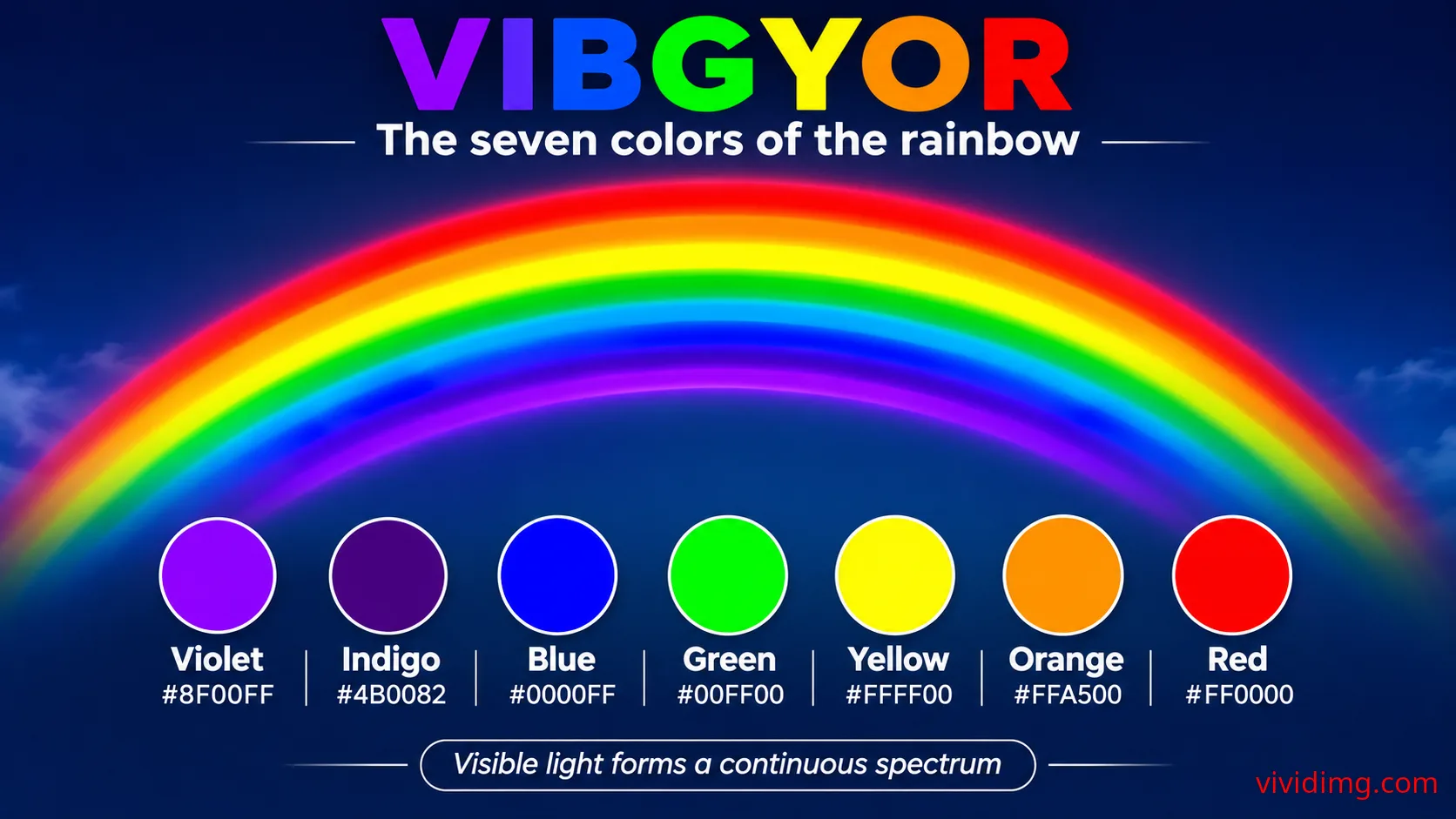
Navy blue is not traditionally listed as a separate color in the seven-part VIBGYOR mnemonic.
The traditional sequence is Violet, Indigo, Blue, Green, Yellow, Orange, and Red.
Navy belongs to the blue color family and represents a darker variation rather than a separate traditional rainbow color category.
Its appearance demonstrates how adjusting RGB channel intensity and lightness can create different shades within the same hue family.
Learning about navy after the traditional VIBGYOR colors helps introduce dark blue variations, RGB intensity, HSL lightness, HSV value, relative luminance, and practical color contrast.
Continue exploring the Color Backgrounds collection
This navy blue color reference belongs to the VividImg Color Backgrounds educational collection, which explores colors progressively from foundational concepts to advanced color relationships and creative applications.
The collection begins with an introduction to the VIBGYOR rainbow and neutral colors such as white, black, and gray. It then examines additional individual chromatic colors, including cyan, magenta, pink, brown, maroon, olive, teal, navy, and other useful digital color references.
Future topics include gold, silver, beige, turquoise, coral, lavender, shades, tints, tones, two-color and three-color mixing, complementary palettes, analogous color harmonies, gradients, textures, accessibility, and advanced color theory.
Navy introduces essential concepts including dark blue shades, RGB channel intensity, HSL lightness, HSV value, color psychology, complementary hues, relative luminance, accessibility, and professional design applications.
Explore the Color Backgrounds collection on VividImg to discover educational color references, practical HEX and RGB codes, visually engaging backgrounds, and detailed explanations for students, teachers, designers, developers, photographers, and creative enthusiasts.
Image statistics
Loading statistics…Top 5 countries
— countries reached · all time
Country data will appear as views are recorded.
Daily views
Last 12 months
- —
- Unique visitors
- —
- Card clicks
- —
- Downloads
- —
- Share actions